Home > U.S. Economy at a Glance: Perspective from the BEA Accounts

U.S. Economy at a Glance: Perspective from the BEA Accounts

BEA produces some of the most closely watched economic statistics that influence decisions of government officials, business people, and individuals. These statistics provide a comprehensive, up-to-date picture of the U.S. economy. The data on this page are drawn from featured BEA economic accounts.

National Economic Accounts:

Gross Domestic Product (GDP)
Current Numbers:
  • 4th quarter 2012: 0.4 percent
  • 3rd quarter 2012: 3.1 percent
Next release: April 26, 2013
Quarterly data: Real gross domestic product -- the output of goods and services produced by labor and property located in the United States -- increased at an annual rate of 0.4 percent in the fourth quarter of 2012 (that is, from the third quarter to the fourth quarter), according to the "third" estimate released by the Bureau of Economic Analysis. In the third quarter, real GDP increased 3.1 percent.

Personal Income
Current Numbers:
  • February 2013: 1.1 percent (personal income)
  • January 2013: -3.7 percent (personal income)
Next release: April 29, 2013
Monthly data: In February 2013, real disposable personal income increased 0.7 percent.

Back to top

Industry Economic Accounts:

Annual Industry Accounts: GDP by Industry
Annual Data: Retail trade and durable goods manufacturing were the leading contributors to the deceleration in U.S. economic growth in 2011, according to revised statistics on the breakout of real gross domestic product (GDP) by industry from the Bureau of Economic Analysis. Real GDP growth slowed in 2011, increasing 1.8 percent after increasing 2.4 percent in 2010. The revised statistics do not change the general picture of the economy: 12 of 22 industry groups contributed to the slowdown in real GDP.
Annual Growth in Real GDP
Graph of Annual Growth in Real GDP
View Larger Image

Annual Percent Changes in Value Added Prices
Graph of Annual Growth in Value Added Prices
View Larger Image

Back to top

International Economic Accounts:

U.S. Balance of Payments (International Transactions)
Current Account Balance:
  • 4th quarter 2012: -$110.4 billion
  • 3rd quarter 2012: -$112.4 billion
  • Annual 2012: -$475.0 billion
  • Annual 2011: -$465.9 billion
Next release: June 14, 2013
Quarterly data: The U.S. current-account deficit decreased $2.0 billion to $110.4 billion (preliminary) in the fourth quarter of 2012. For the year 2012, the current- account deficit increased $9.1 billion to $475.0 billion (preliminary).
Quarterly Data
Quarterly Data Graph of U.S. Current-Account Transactions
View Larger Image


Annual Data
Quarterly Data Graph of U.S. Current-Account Transactions
View Larger Image

International Investment Position
Net International Investment Position at End of Quarter:
  • 4th quarter 2012: -$4,416.2 billion
  • 3rd quarter 2012: -$4,663.4 billion
Next release: June 25, 2013
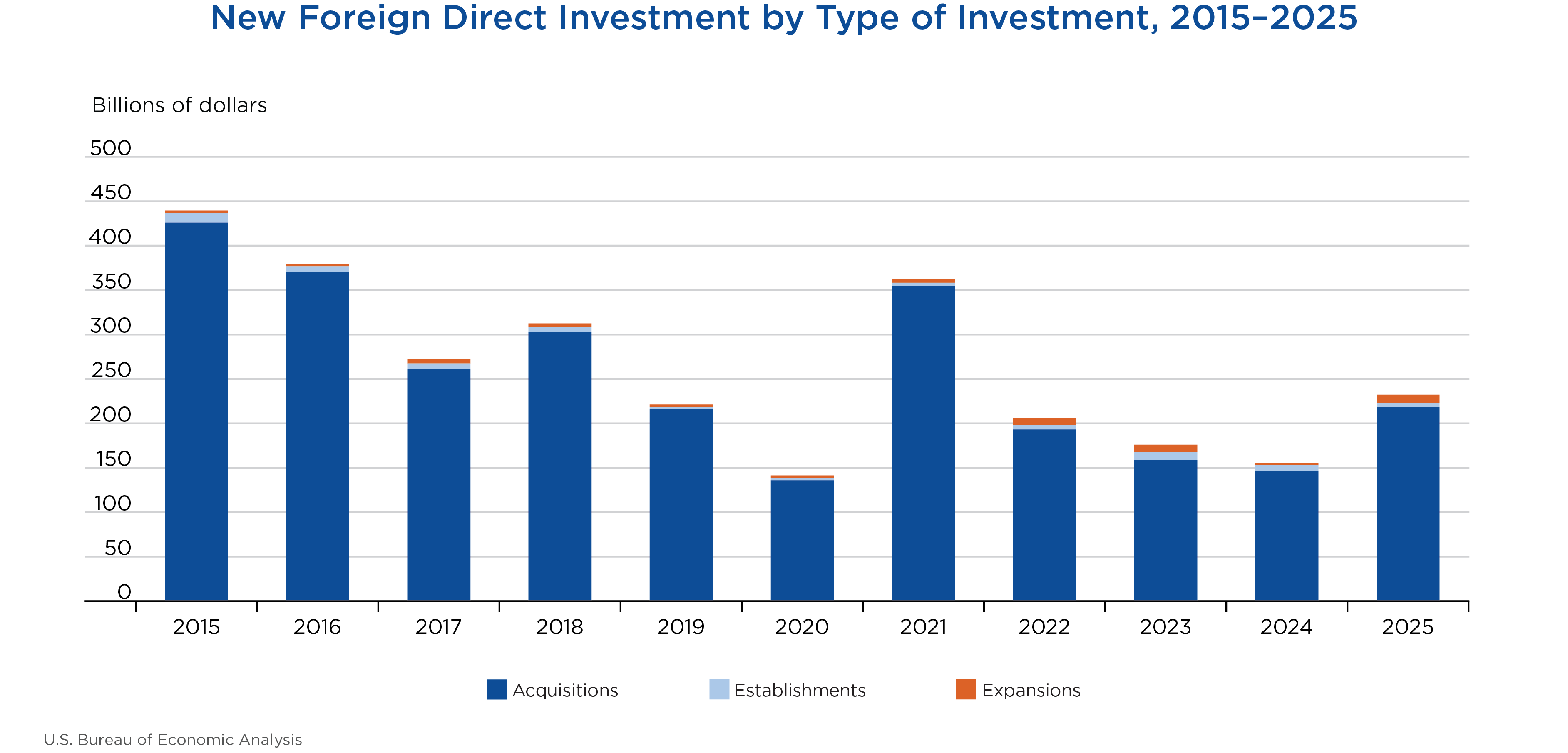
Quarterly and annual data: The U.S. net international investment position at the end of the fourth quarter and year 2012 was -$4,416.2 billion (preliminary), as the value of foreign investments in the United States exceeded the value of U.S. investments abroad.
Quarterly DataGraph of U.S. Net International Investment Position at End of Quarter
View Larger Image

Annual DataGraph of U.S. Net International Investment Position at End of Year
View Larger Image

International Trade in Goods and Services
Trade Balance:
  • February 2013: -$43.0 billion
  • January 2013: -$44.5 billion
Next release: May 2, 2013
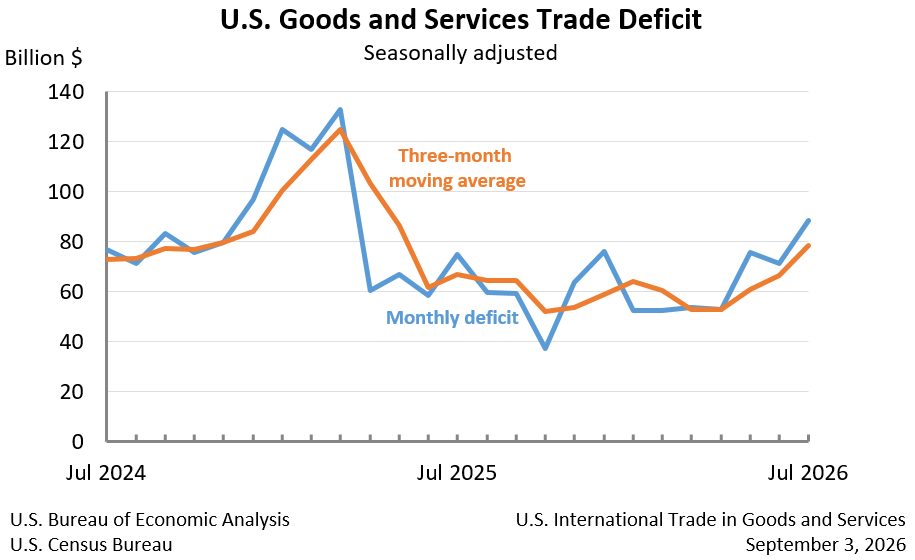
Monthly: Total February exports of $186.0 billion and imports of $228.9 billion resulted in a goods and services deficit of $43.0 billion.
Monthly Data Monthly Graph of Balance on Goods and Services Trade
View Larger Image


Back to top

Regional Economic Accounts:

Gross Domestic Product (GDP) by State
Next release: June 2013
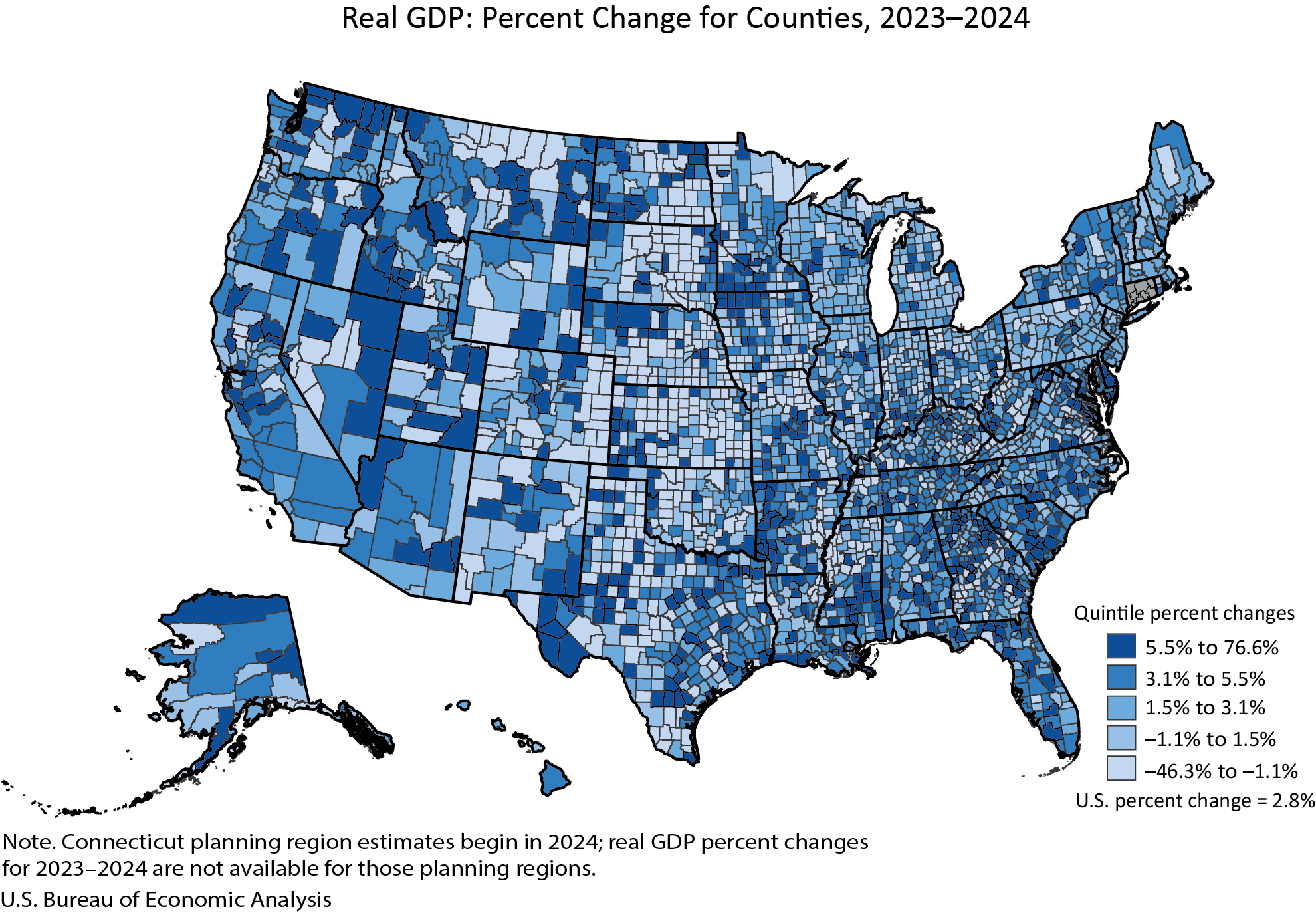
Annual Data: Real gross domestic product (GDP) increased in 43 states and the District of Columbia in 2011, according to new statistics released today by the U.S. Bureau of Economic Analysis (BEA) that breakdown GDP by state. Durable-goods manufacturing, professional, scientific, and technical services, and information services were the leading contributors to real U.S. economic growth. U.S. real GDP by state grew 1.5 percent in 2011 after a 3.1 percent increase in 2010.

Gross Domestic Product (GDP) by Metropolitan Area
Annual data: Real GDP increased in 242 of the nation’s 366 metropolitan areas in 2011 led by growth in professional and business services, durable-goods manufacturing, and trade, according to new statistics released today by the U.S. Bureau of Economic Analysis. Real GDP in metropolitan areas increased 1.6 percent in 2011 after increasing 3.1 percent in 2010.

State Personal Income (SPI)
Next release: June 28, 2013
Quarterly data: In the fourth quarter of 2012, average state personal income growth accelerated to 1.9 percent from 0.6 percent in the third quarter, the fastest pace since the first quarter of 2011.
Annual data: Average state personal income growth slowed to 3.5 percent in 2012 from 5.2 percent in 2011. State personal income growth ranged from -0.2 percent in South Dakota to 12.4 percent in North Dakota.
Quarterly DataMap of Quarterly State Personal Income
View Larger Image

Annual DataMap of State Personal Income
View Larger Image

Local Area Personal Income
Metropolitan area data: Personal income rose in 2011 in all of the nation's 366 metropolitan statistical areas (MSAs) for the first time since 2007. Personal income growth ranged from 14.8 percent in Odessa, Texas to 1.0 percent in Rochester, Minnesota.
County data: Personal income rose in 3,062 of the nation's 3,113 counties in 2011, with growth ranging from 62.2 percent in King County, Texas to -28.8 percent in Lynn County, Texas.
Annual data:
Metropolitan Area DataMap of Local Area Personal Income
View Larger Image

County DataMap of Local Area Personal Income
View Larger Image

Back to top