
Bureau of Economic Analysis
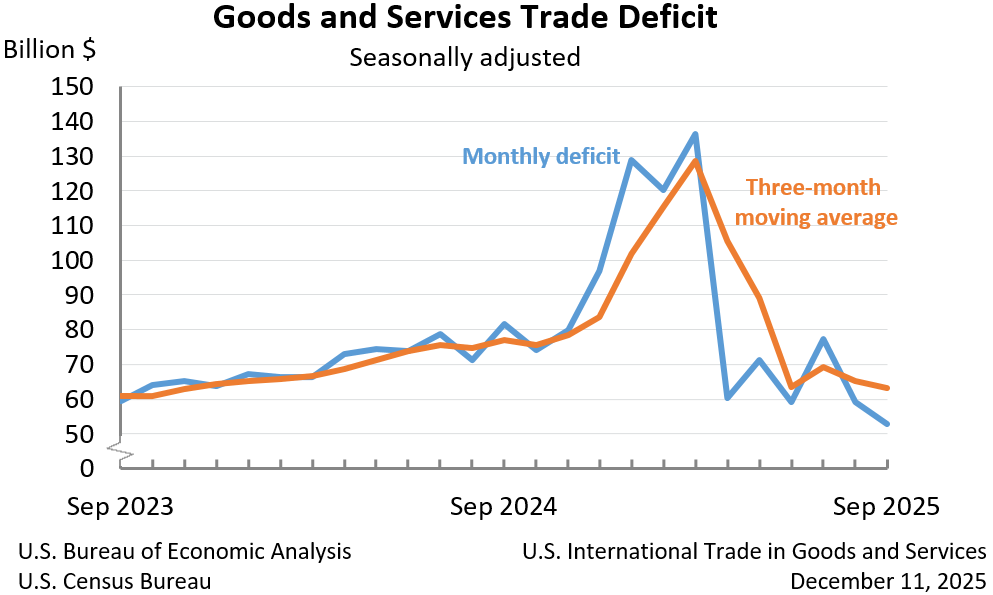
U.S. International Trade in Goods and Services, September 2025
The U.S. goods and services trade deficit decreased in September 2025 according to the U.S. Bureau of Economic Analysis and the U.S. Census Bureau. The deficit decreased from $59.3 billion in August (revised) to $52.8 billion in September, as exports increased more than imports. The goods deficit decreased $7.1 billion in September to $79.0 billion. The services surplus decreased $0.6 billion in September to $26.2 billion.
Principal Federal Economic Indicators
Noteworthy




The Latest
U.S. International Investment Position, 4th quarter and year 2017
The U.S. net international investment position decreased to -$7,845.8 billion (preliminary) at the end of the fourth quarter from -$7,739.7 billion (revised) at the end of the third quarter. The $106.1 billion decrease reflected net financial transactions of –$52.4 billion and net other changes in position, such as price and exchange-rate changes, of -$53.8 billion.
Personal Saving Increases in February
Personal income increased 0.4 percent in February, the same increase as in January. Wages and salaries, the largest component of personal income, increased 0.5 percent in February after increasing 0.6 percent in January.
Personal Income and Outlays, February 2018
Personal income increased 0.4 percent in February, the same increase as in January. Wages and salaries, the largest component of personal income, increased 0.5 percent in February after increasing 0.6 percent in January.
GDP Increases in Fourth Quarter
Real gross domestic product (GDP) increased 2.9 percent in the fourth quarter of 2017, according to the "third" estimate released by the Bureau of Economic Analysis. In the third quarter, real GDP increased 3.2 percent.
Gross Domestic Product, 4th quarter and annual 2017 (third estimate); Corporate Profits, 4th quarter and annual 2017
Real gross domestic product (GDP) increased at an annual rate of 2.9 percent in the fourth quarter of 2017 (table 1), according to the "third" estimate released by the Bureau of Economic Analysis. In the third quarter, real GDP increased 3.2 percent.
State Personal Income Rises in 2017
State personal income increased 3.1 percent on average in 2017, after increasing 2.3 percent in 2016. In 2017, personal income increased in all states and the District of Columbia except one, North Dakota. The percent change in personal income across all states ranged from 4.8 percent in Washington to -0.3 percent in North Dakota.
State Quarterly Personal Income, 4th quarter 2017; State Annual Personal Income, 2017 (preliminary)
State personal income increased 3.1 percent on average in 2017, after increasing 2.3 percent in 2016. In 2017, personal income increased in all states and the District of Columbia except one, North Dakota. The percent change in personal income across all states ranged from 4.8 percent in Washington to -0.3 percent in North Dakota.
U.S. Current-Account Deficit Increases in Fourth Quarter 2017
The U.S. current-account deficit increased to $128.2 billion (preliminary) in the fourth quarter of 2017 from $101.5 billion (revised) in the third quarter of 2017. As a percentage of U.S. GDP, the deficit increased to 2.6 percent from 2.1 percent. The previously published current-account deficit for the third quarter was $100.6 billion.
U.S. International Transactions, 4th quarter and Year 2017
The U.S. current-account deficit increased to $128.2 billion (preliminary) in the fourth quarter of 2017 from $101.5 billion (revised) in the third quarter of 2017. As a percentage of U.S. GDP, the deficit increased to 2.6 percent from 2.1 percent. The previously published current-account deficit for the third quarter was $100.6 billion.
Initial Estimates Show Digital Economy Accounted for 6.5 Percent of GDP in 2016
The Bureau of Economic Analysis released, for the first time, preliminary statistics and an accompanying report exploring the size and growth of the digital economy. Goods and services that are primarily digital accounted for 6.5 percent of the U.S. economy, or $1.2 trillion, in 2016, after a decade of growing faster than the U.S. economy overall, BEA’s research shows.
From 2006 to 2016, the digital economy grew at an average annual…