
Bureau of Economic Analysis
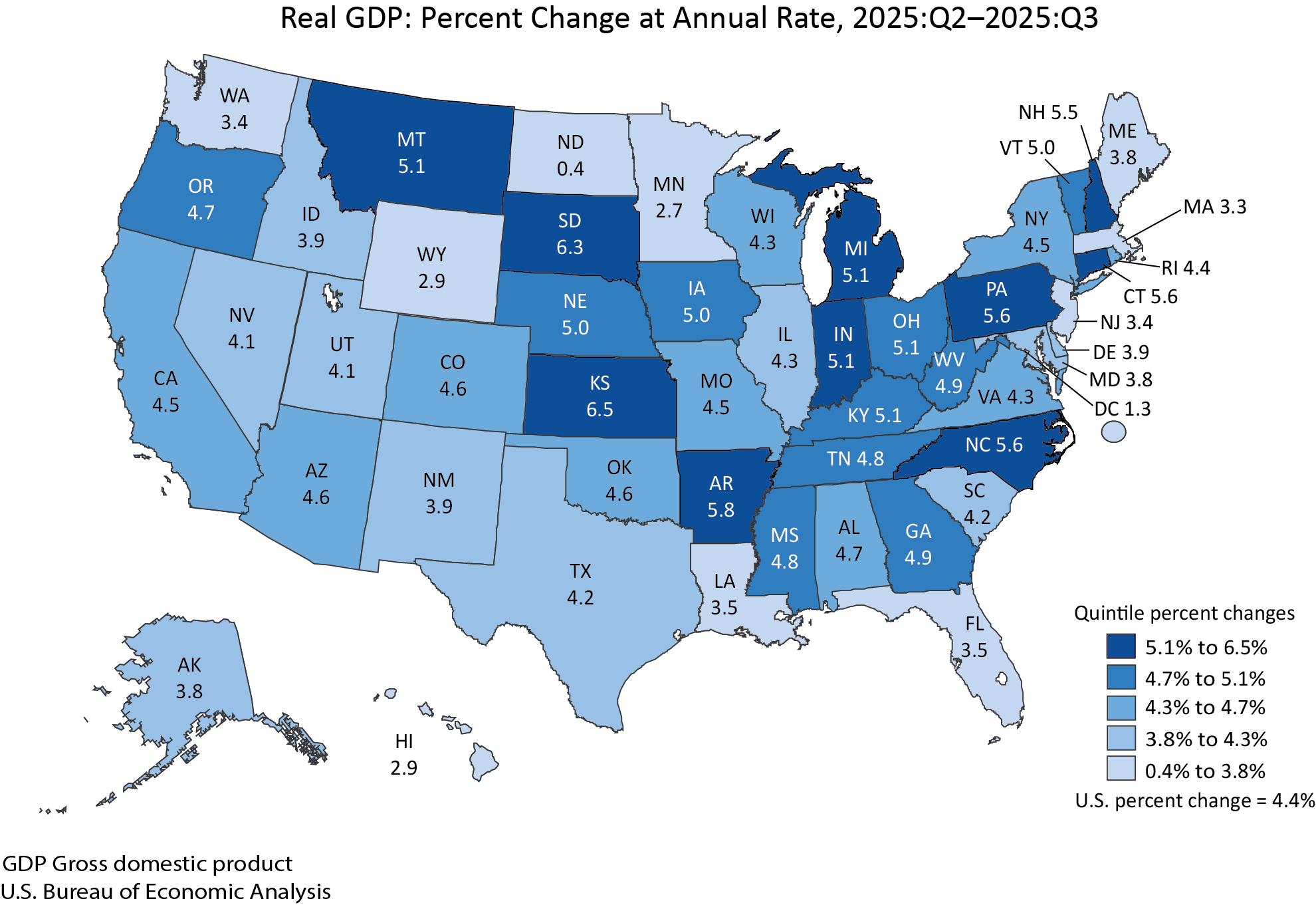
Gross Domestic Product by State and Personal Income by State, 3rd Quarter 2025
Real gross domestic product (GDP) increased in all 50 states and the District of Columbia in the third quarter of 2025. State-level changes ranged from a 6.5 percent increase in Kansas to a 0.4 percent increase in North Dakota.
Personal income increased in all 50 states and the District of Columbia in the third quarter of 2025. State-level changes ranged from a 6.3 percent increase in Kansas to a 0.1 percent increase in Louisiana.
Principal Federal Economic Indicators
Noteworthy




The Latest
New FAQs Aim to Help Private Funds Determine When They Have to File a Survey to BEA for U.S. Direct Investment Abroad
Gaining a detailed picture of the role the United States plays in the global market place is made easier by the wealth of international investment statistics produced by the Bureau of Economic Analysis. So it’s critically important that we get the most accurate information possible from businesses, private funds, and others who fill out our BEA surveys.
Coming in July: BEA to Launch New Tools for Analyzing Economic Growth
The Bureau of Economic Analysis plans to launch two new statistics that will serve as tools to help businesses, economists, policymakers and the American public better analyze the performance of the U.S. economy. These tools will be available on July 30 and emerge from an annual BEA process where improvements and revisions to GDP data are implemented. BEA created these two new tools in response to demand from our customers.
Average of…
BEA's Brent Moulton to Receive 2015 Julius Shiskin Award
Brent Moulton, Associate Director for National Economic Accounts of the Bureau of Economic Analysis (BEA), has been selected to receive the 2015 Julius Shiskin Memorial Award for Economic Statistics. The award recognizes unusually original and important contributions in the development of economic statistics or in the use of statistics in interpreting the economy.
BEA Continues to Explore Reliability of Successive Vintages of Real GDP Estimates
The U.S.
March 2015 Trade Gap is $51.4 Billion
The U.S. monthly international trade deficit increased in March 2015 according to the U.S. Bureau of Economic Analysis and the U.S. Census Bureau. The deficit increased from $35.9 billion in February (revised) to $51.4 billion in March, as imports increased more than exports. The previously published February deficit was $35.4 billion. The goods deficit increased $14.9 billion from February to $70.6 billion in March. The services surplus…
U.S. International Trade in Goods and Services, March 2015
U.S. Census Bureau U.S. Bureau of Economic Analysis NEWS U.S. Department of Commerce * Washington, DC 20230 U.S. INTERNATIONAL TRADE IN GOODS AND SERVICES March 2015 The U.S. Census Bureau and the U.S.
New Data Tool Provides Fast Access to Trade and Investment Stats for Countries
The Bureau of Economic Analysis launched today a new data tool on its website that gives users a snapshot of statistics on trade and investment between the United States and another country by simply clicking on a world map.
These fast facts at your fingertips can include:
Real Consumer Spending Rose in March
Personal income increased less than 0.1 percent in March after rising 0.4 percent in February. Wages and salaries, the largest component of personal income, rose 0.2 percent in March after rising 0.3 percent in February.
Current-dollar disposable personal income (DPI), after-tax income, increased less than 0.1 percent in March after rising 0.5 percent in February.
Real DPI, income adjusted for taxes and…
Personal Income and Outlays, March 2015
Personal income increased $6.2 billion, or less than 0.1 percent, and disposable personal income (DPI) increased $1.6 billion, or less than 0.1 percent, in March, according to the Bureau of Economic Analysis. Personal consumption expenditures (PCE) increased $53.4 billion, or 0.4 percent.
GDP Up Slightly in First Quarter
Real gross domestic product (GDP) increased 0.2 percent in the first quarter of 2015, according to the “advance” estimate released by the Bureau of Economic Analysis. In the fourth quarter of 2014, real GDP increased 2.2 percent. In the first quarter, the dollar strengthened against major currencies, imports and exports were delayed because of labor disputes in key ports, energy prices declined, and several regions experienced severe weather…