
Bureau of Economic Analysis
Gross Domestic Product by State and Personal Income by State, 3rd Quarter 2025
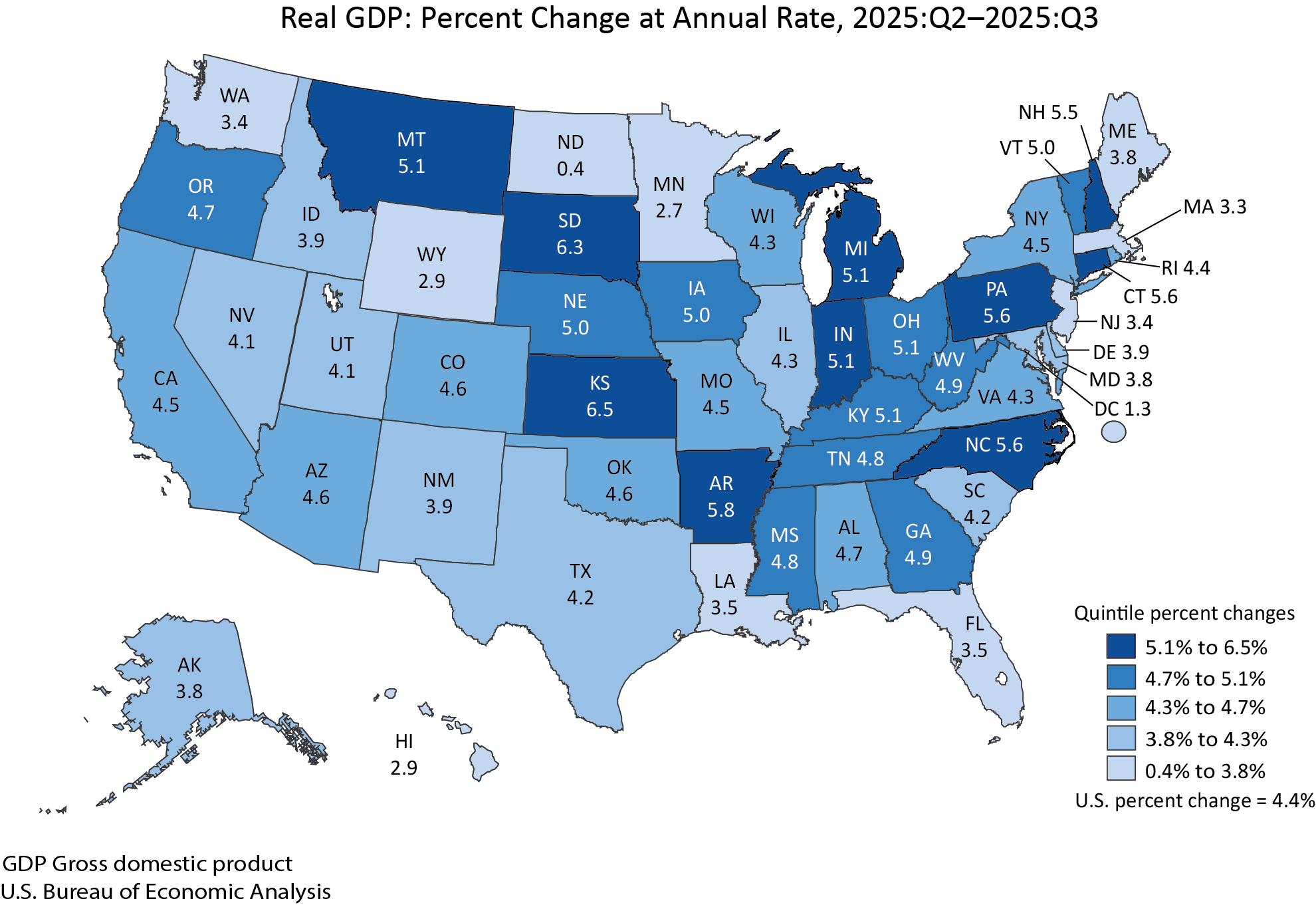
Real gross domestic product (GDP) increased in all 50 states and the District of Columbia in the third quarter of 2025. State-level changes ranged from a 6.5 percent increase in Kansas to a 0.4 percent increase in North Dakota.
Personal income increased in all 50 states and the District of Columbia in the third quarter of 2025. State-level changes ranged from a 6.3 percent increase in Kansas to a 0.1 percent increase in Louisiana.
Principal Federal Economic Indicators
Noteworthy




The Latest
Personal Income: More Than Your Paycheck
When someone asks you what your income is, what do you tell them? Probably most of you would respond with the salary you earn from your job, right? Well, your income includes more than just that paycheck you receive every other week.
New Census Mobile App to Feature BEA Data
Want to keep tabs on the latest gross domestic product data while waiting for lunch? A new mobile app from the Census Bureau puts live access to key economic indicators at your fingertips. It’s the perfect tool for geeking out on the go.
June Trade Gap is $42.9 Billion
The U.S. monthly international trade deficit decreased in June 2012, according to the U.S. Bureau of Economic Analysis and the U.S. Census Bureau. The deficit decreased from $48.0 billion (revised) in May to $42.9 billion in June, as exports increased and imports decreased. The previously published May deficit was $48.7 billion. The goods deficit decreased $5.4 billion from May to $57.5 billion in June, and the services surplus decreased $0.3…
Personal Income Picks Up in June
Personal income increased 0.5 percent in June after increasing 0.3 percent in May. Wages and salaries, the largest component of personal income, increased 0.5 percent in June after increasing 0.1 percent in May.
Current-dollar disposable personal income (DPI), after-tax income, increased 0.4 percent in June after increasing 0.3 percent in May.
Real DPI, income adjusted for taxes and inflation, increased 0.3 percent in June…
Personal Income and Outlays, June 2012. Revised estimates: 2009 through May 2012
Personal income increased $61.8 billion, or 0.5 percent, and disposable personal income (DPI) increased $52.4 billion, or 0.4 percent, in June, according to the Bureau of Economic Analysis. Personal consumption expenditures (PCE) decreased $1.3 billion, or less than 0.1 percent. In May, personal income increased $39.0 billion, or 0.3 percent, DPI increased $31.7 billion, or 0.3 percent, and PCE decreased $13.3 billion, or 0.1 percent, based on…
GDP Growth Moderates in Second Quarter
Real gross domestic product (GDP) rose 1.5 percent in the second quarter after rising 2.0 percent in the first quarter, according to the Bureau of Economic Analysis. According to the 2012 annual revision, the first-quarter growth rate was revised up 0.1 percentage point.
Real GDP second-quarter highlights
Gross Domestic Product, 2nd quarter 2012 (advance estimate); Revised Estimates: 2009 through First Quarter 2012
Real gross domestic product -- the output of goods and services produced by labor and property located in the United States -- increased at an annual rate of 1.5 percent in the second quarter of 2012, (that is, from the first quarter to the second quarter), according to the "advance" estimate released by the Bureau of Economic Analysis.
Revising Economic Indicators: Here's Why the Numbers Can Change
In late June, the Bureau of Economic Analysis (BEA) reported that the economy grew at a 1.9 percent annual rate in the first quarter of 2011. This, our third estimate for the quarter, turned out to be lower than our initial estimate of a 2.2 percent growth rate made in late April. When we revise a major economic indicator, it’s not unusual for some to ask us, “Why didn’t you get it right the first time?”
Quarterly GDP by Industry Data Improves Understanding of the Economy
In 2009, annual gross domestic product (GDP) for durable goods manufacturing showed a double-digit decline. The industry was the leading annual contributor to the bottoming out of the U.S. economy for that year. But looking at the results through a new experimental quarterly data series reveals a more nuanced and complete picture of what was happening in durable goods manufacturing. It shows that the decline in 2009 largely…