
Bureau of Economic Analysis
Gross Domestic Product by County and Personal Income by County, 2024
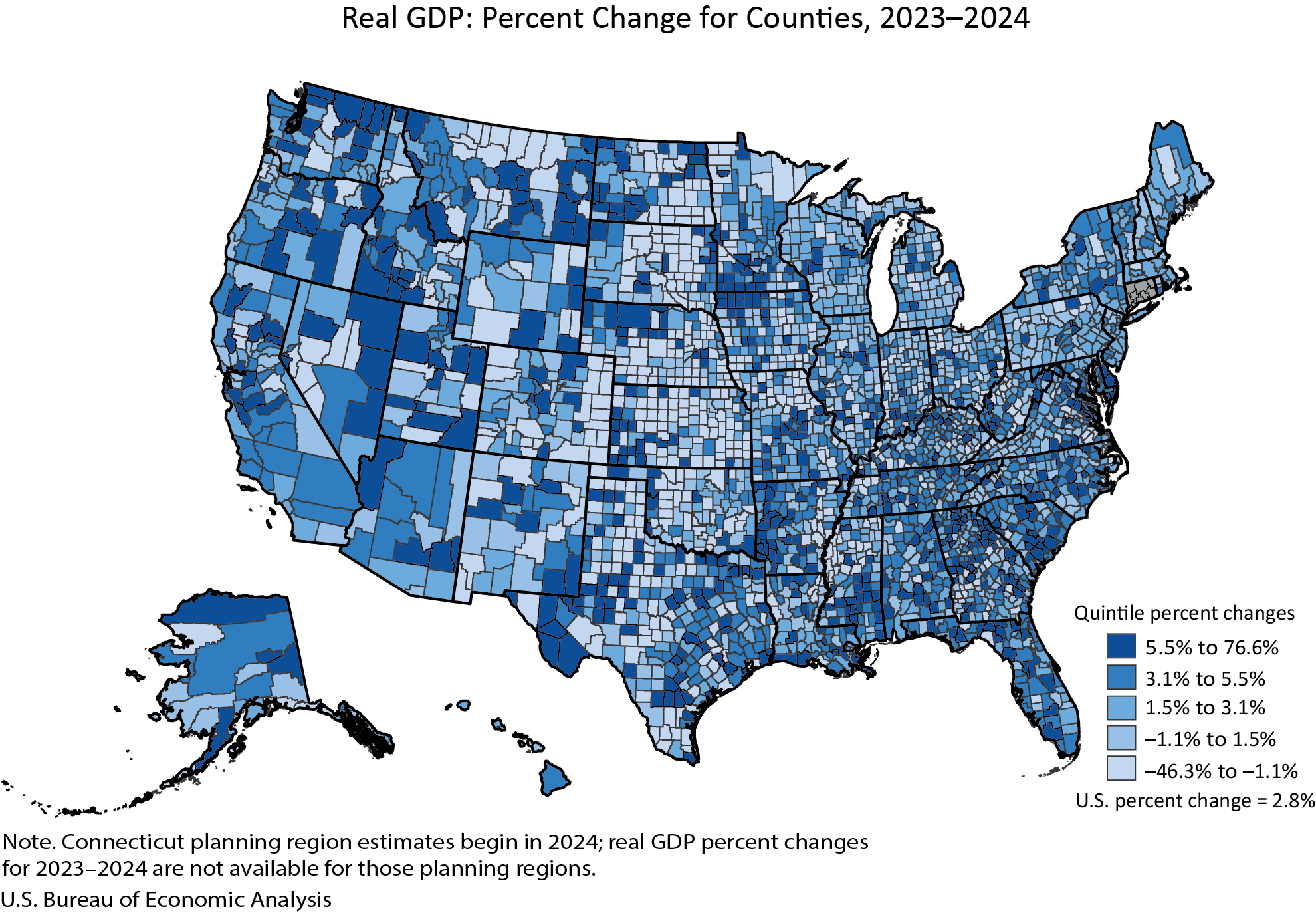
Real gross domestic product (GDP) increased in 2,273 counties, decreased in 809 counties, and was unchanged in 24 counties in 2024. County-level changes ranged from a 76.6 percent increase in Carter County, MT, to a 46.3 percent decline in Baca County, CO.
Personal income, in current dollars, increased in 2,768 counties, decreased in 331, and was unchanged in 7 counties in 2024. County-level changes ranged from a 22.6 percent increase in Harding County, SD, to a 23.3 percent decline in Issaquena County, MS.
Principal Federal Economic Indicators
Noteworthy




The Latest
Gross Domestic Product (Second Estimate) Corporate Profits (Preliminary Estimate) First Quarter 2023
Real gross domestic product (GDP) increased at an annual rate of 1.3 percent in the first quarter of 2023, according to the "second" estimate. In the fourth quarter of 2022, real GDP increased 2.6 percent. The GDP estimate for the first quarter was revised up 0.2 percentage point from the "advance" estimate, primarily reflecting an upward revision to inventory investment.
Gross Domestic Product (Second Estimate), Corporate Profits (Preliminary Estimate), First Quarter 2023
Real gross domestic product (GDP) increased at an annual rate of 1.3 percent in the first quarter of 2023, according to the “second” estimate. In the fourth quarter of 2022, real GDP increased 2.6 percent. The GDP estimate for the first quarter was revised up 0.2 percentage point from the “advance” estimate, primarily reflecting an upward revision to inventory investment. Profits decreased 5.1 percent at a quarterly rate in the first quarter…
Gross Domestic Product for the U.S. Virgin Islands, 2021
Real gross domestic product (GDP) for the U.S. Virgin Islands increased 2.8 percent in 2021 after decreasing 1.9 percent in 2020. The increase in real GDP reflected increases in exports and personal consumption expenditures. These increases were partly offset by decreases in private inventory investment, private fixed investment, and government spending. Imports, a subtraction item in the calculation of GDP, also decreased.
Gross Domestic Product for the U.S. Virgin Islands, 2021
Real gross domestic product (GDP) for the U.S. Virgin Islands increased 2.8 percent in 2021 after decreasing 1.9 percent in 2020, according to statistics released today by the U.S. Bureau of Economic Analysis.
The increase in real GDP reflected increases in exports and personal consumption expenditures. These increases were partly offset by decreases in private inventory investment, private fixed investment, and government spending.…
March 2023 Trade Gap is $64.2 Billion
The U.S. goods and services trade deficit decreased from $70.6 billion in February (revised) to $64.2 billion in March, as exports increased and imports decreased. The goods deficit decreased $6.4 billion to $86.6 billion, and the services surplus decreased less than $0.1 billion to $22.4 billion.
U.S. International Trade in Goods and Services, March 2023
The U.S. monthly international trade deficit decreased in March 2023 according to the U.S. Bureau of Economic Analysis and the U.S. Census Bureau. The deficit decreased from $70.6 billion in February (revised) to $64.2 billion in March as exports increased and imports decreased. The goods deficit decreased $6.4 billion in March to $86.6 billion. The services surplus decreased less than $0.1 billion in March to $22.4 billion.
Patricia Abaroa Named New BEA Deputy Director
Patricia Abaroa is the new Deputy Director of the Bureau of Economic Analysis, bringing decades of economic accounting experience to the post.
Personal Income and Outlays, March 2023
Personal income increased $67.9 billion, or 0.3 percent at a monthly rate, while consumer spending increased $8.2 billion, or less than 0.1 percent, in March. The personal saving rate (that is, personal saving as a percentage of disposable personal income) was 5.1 percent in March, compared with 4.8 percent in February.
Personal Income and Outlays, March 2023
Personal income increased $67.9 billion, or 0.3 percent at a monthly rate, while consumer spending increased $8.2 billion, or less than 0.1 percent, in March. The personal saving rate (that is, personal saving as a percentage of disposable personal income) was 5.1 percent in March, compared with 4.8 percent in February.
Gross Domestic Product, First Quarter 2023 (Advance Estimate)
Real gross domestic product (GDP) increased at an annual rate of 1.1 percent in the first quarter of 2023, according to the "advance" estimate. In the fourth quarter of 2022, real GDP increased 2.6 percent. The increase in the first quarter primarily reflected an increase in consumer spending that was partly offset by a decrease in inventory investment.