
Bureau of Economic Analysis
U.S. International Trade in Goods and Services, September 2025
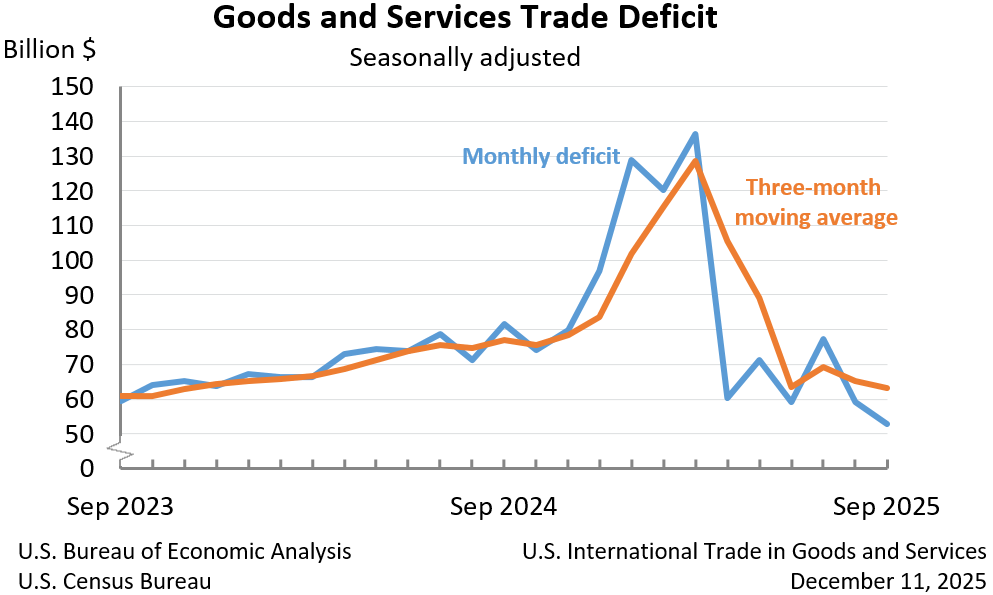
The U.S. goods and services trade deficit decreased in September 2025 according to the U.S. Bureau of Economic Analysis and the U.S. Census Bureau. The deficit decreased from $59.3 billion in August (revised) to $52.8 billion in September, as exports increased more than imports. The goods deficit decreased $7.1 billion in September to $79.0 billion. The services surplus decreased $0.6 billion in September to $26.2 billion.
Principal Federal Economic Indicators
Noteworthy




The Latest
Gross Domestic Product (Second Estimate) and Corporate Profits (Preliminary), Second Quarter 2022
Real gross domestic product (GDP) decreased at an annual rate of 0.6 percent in the second quarter of 2022, following a decrease of 1.6 percent in the first quarter. The second-quarter decrease was revised up 0.3 percentage point from the "advance" estimate released in July. The smaller decrease in the second quarter, compared to the first quarter, primarily reflected an upturn in exports and a smaller decrease in federal government…
Gross Domestic Product (Second Estimate) Corporate Profits (Preliminary Estimate) Second Quarter 2022
Real gross domestic product (GDP) decreased at an annual rate of 0.6 percent in the second quarter of 2022, following a decrease of 1.6 percent in the first quarter. The second-quarter decrease was revised up 0.3 percentage point from the “advance” estimate released in July. The smaller decrease in the second quarter, compared to the first quarter, primarily reflected an upturn in exports and a smaller decrease in federal government spending…
Activities of U.S. Affiliates of Foreign Multinational Enterprises, 2020
Majority-owned U.S. affiliates (MOUSAs) of foreign multinational enterprises employed 7.86 million workers in the United States in 2020, a 2.8 percent decrease from 8.08 million workers in 2019, according to the U.S. Bureau of Economic Analysis. MOUSAs accounted for 6.4 percent of total private industry employment in the United States in 2020.
Activities of U.S. Affiliates of Foreign Multinational Enterprises, 2020
Majority-owned U.S. affiliates (MOUSAs) of foreign multinational enterprises employed 7.86 million workers in the United States in 2020, a 2.8 percent decrease from 8.08 million workers in 2019, according to the U.S. Bureau of Economic Analysis. MOUSAs accounted for 6.4 percent of total private-industry employment in the United States in 2020.
June 2022 Trade Gap is $79.6 Billion
The U.S. monthly international trade deficit decreased in June 2022 according to the U.S. Bureau of Economic Analysis and the U.S. Census Bureau. The deficit decreased from $84.9 billion in May (revised) to $79.6 billion in June, as exports increased and imports decreased. The previously published May deficit was $85.5 billion. The goods deficit decreased$4.9 billion in June to $99.5 billion. The services surplus increased $0.3 billion in…
U.S. International Trade in Goods and Services, June 2022
The U.S. monthly international trade deficit decreased in June 2022 according to the U.S. Bureau of Economic Analysis and the U.S. Census Bureau. The deficit decreased from $84.9 billion in May (revised) to $79.6 billion in June, as exports increased and imports decreased. The previously published May deficit was $85.5 billion. The goods deficit decreased $4.9 billion in June to $99.5 billion. The services surplus increased $0.3 billion in June…
Personal Income and Outlays, June 2022
Personal income increased $133.5 billion, or 0.6 percent at a monthly rate, while consumer spending increased $181.1 billion, or 1.1 percent, in June. The increase in personal income primarily reflected increases in compensation and proprietors’ income. The personal saving rate (that is, personal saving as a percentage of disposable personal income) was 5.1 percent in June, compared with 5.5 percent in May.
Personal Income and Outlays, June 2022
Personal income increased $133.5 billion, or 0.6 percent at a monthly rate, while consumer spending increased $181.1 billion, or 1.1 percent, in June. The increase in personal income primarily reflected increases in compensation and proprietors’ income. The personal saving rate (that is, personal saving as a percentage of disposable personal income) was 5.1 percent in June, compared with 5.5 percent in May.
Gross Domestic Product, Second Quarter 2022
Real gross domestic product (GDP) decreased at an annual rate of 0.9 percent in the second quarter of 2022, following a decrease of 1.6 percent in the first quarter. The smaller decrease in the second quarter primarily reflected an upturn in exports and a smaller decrease in federal government spending. For more details, including source data, refer to the Technical Note.
Gross Domestic Product, Second Quarter 2022 (Advance Estimate)
Real gross domestic product (GDP) decreased at an annual rate of 0.9 percent in the second quarter of 2022, following a decrease of 1.6 percent in the first quarter. The smaller decrease in the second quarter primarily reflected an upturn in exports and a smaller decrease in federal government spending.