
Bureau of Economic Analysis
Gross Domestic Product by State and Personal Income by State, 3rd Quarter 2025
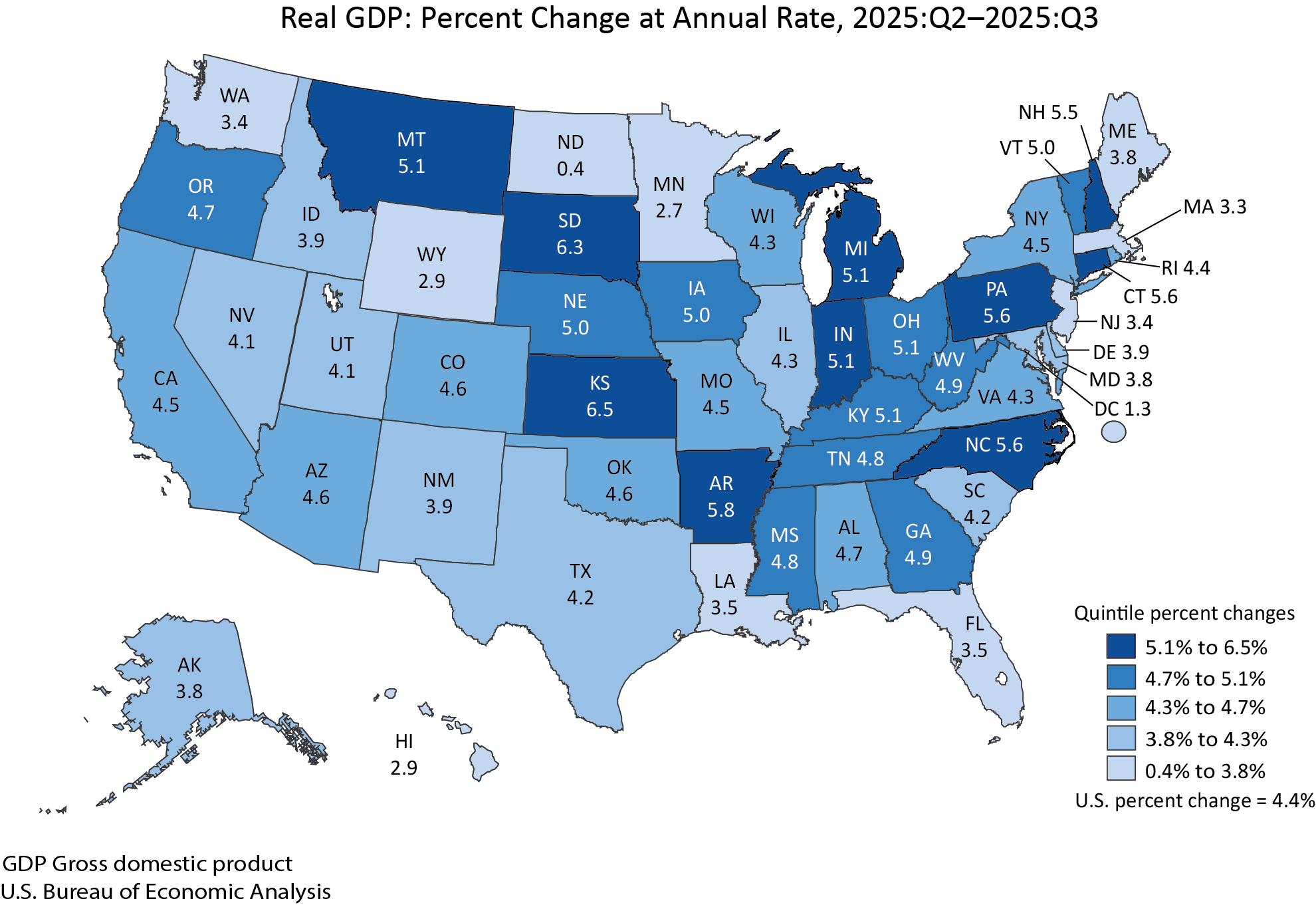
Real gross domestic product (GDP) increased in all 50 states and the District of Columbia in the third quarter of 2025. State-level changes ranged from a 6.5 percent increase in Kansas to a 0.4 percent increase in North Dakota.
Personal income increased in all 50 states and the District of Columbia in the third quarter of 2025. State-level changes ranged from a 6.3 percent increase in Kansas to a 0.1 percent increase in Louisiana.
Principal Federal Economic Indicators
Noteworthy




The Latest
Personal Income and Outlays, October 2020
Personal income decreased 0.7 percent while consumer spending increased 0.5 percent in October as federal economic recovery payments and pandemic-related assistance programs continued to wind down.
Personal Income and Outlays, October 2020
Personal income decreased 0.7 percent while consumer spending increased 0.5 percent in October as federal economic recovery payments and pandemic-related assistance programs continued to wind down.
Gross Domestic Product, Third Quarter 2020 (Second Estimate) Corporate Profits, Third Quarter 2020 (Preliminary Estimate)
Real gross domestic product (GDP) increased at an annual rate of 33.1 percent in the third quarter of 2020, as efforts continued to reopen businesses and resume activities that were postponed or restricted due to COVID-19. The increase is the same as in the “advance” estimate released in October. In the second quarter of 2020, real GDP decreased 31.4 percent. For more details, including source data, see the Technical Note.
Gross Domestic Product, Third Quarter 2020 (Second Estimate); Corporate Profits, Third Quarter 2020 (Preliminary Estimate)
Real gross domestic product (GDP) increased at an annual rate of 33.1 percent in the third quarter of 2020, as efforts continued to reopen businesses and resume activities that were postponed or restricted due to COVID-19. The increase is the same as in the “advance” estimate released in October. In the second quarter of 2020, real GDP decreased 31.4 percent.
Personal Income by County and Metropolitan Area, 2019
In 2019, personal income increased in 2,964 counties, decreased in 139, and was unchanged in 10. Personal income increased 4.0 percent in the metropolitan portion of the United States and increased 3.5 percent in the nonmetropolitan portion.
Personal Income by County and Metropolitan Area, 2019
In 2019, personal income increased in 2,964 counties, decreased in 139, and was unchanged in 10. Personal income increased 4.0 percent in the metropolitan portion of the United States and increased 3.5 percent in the nonmetropolitan portion.
Activities of U.S. Affiliates of Foreign Multinational Enterprises, 2018
Majority-owned U.S. affiliates (MOUSAs) of foreign multinational enterprises (MNEs) employed 7.8 million workers in the United States in 2018, a 1.9 percent increase from 7.7 million in 2017, according to the Bureau of Economic Analysis.
Activities of U.S. Affiliates of Foreign Multinational Enterprises, 2018
Majority-owned U.S. affiliates (MOUSAs) of foreign multinational enterprises (MNEs) employed 7.8 million workers in the United States in 2018, a 1.9 percent increase from 7.7 million in 2017, according to the Bureau of Economic Analysis.
Outdoor Recreation Satellite Account, U.S. and States, 2019
The new U.S. data show that the outdoor recreation economy accounted for 2.1 percent ($459.8 billion) of current-dollar gross domestic product (GDP) for the nation in 2019. At the state level, outdoor recreation value added as a share of state GDP ranged from 5.8 percent in Hawaii to 1.3 percent in Connecticut. The share was 1.1 percent in the District of Columbia.
Outdoor Recreation Satellite Account, U.S. and States, 2019
The new U.S. data show that the outdoor recreation economy accounted for 2.1 percent ($459.8 billion) of current-dollar gross domestic product (GDP) for the nation in 2019. At the state level, outdoor recreation value added as a share of state GDP ranged from 5.8 percent in Hawaii to 1.3 percent in Connecticut. The share was 1.1 percent in the District of Columbia.