
Bureau of Economic Analysis
Gross Domestic Product by County and Personal Income by County, 2024
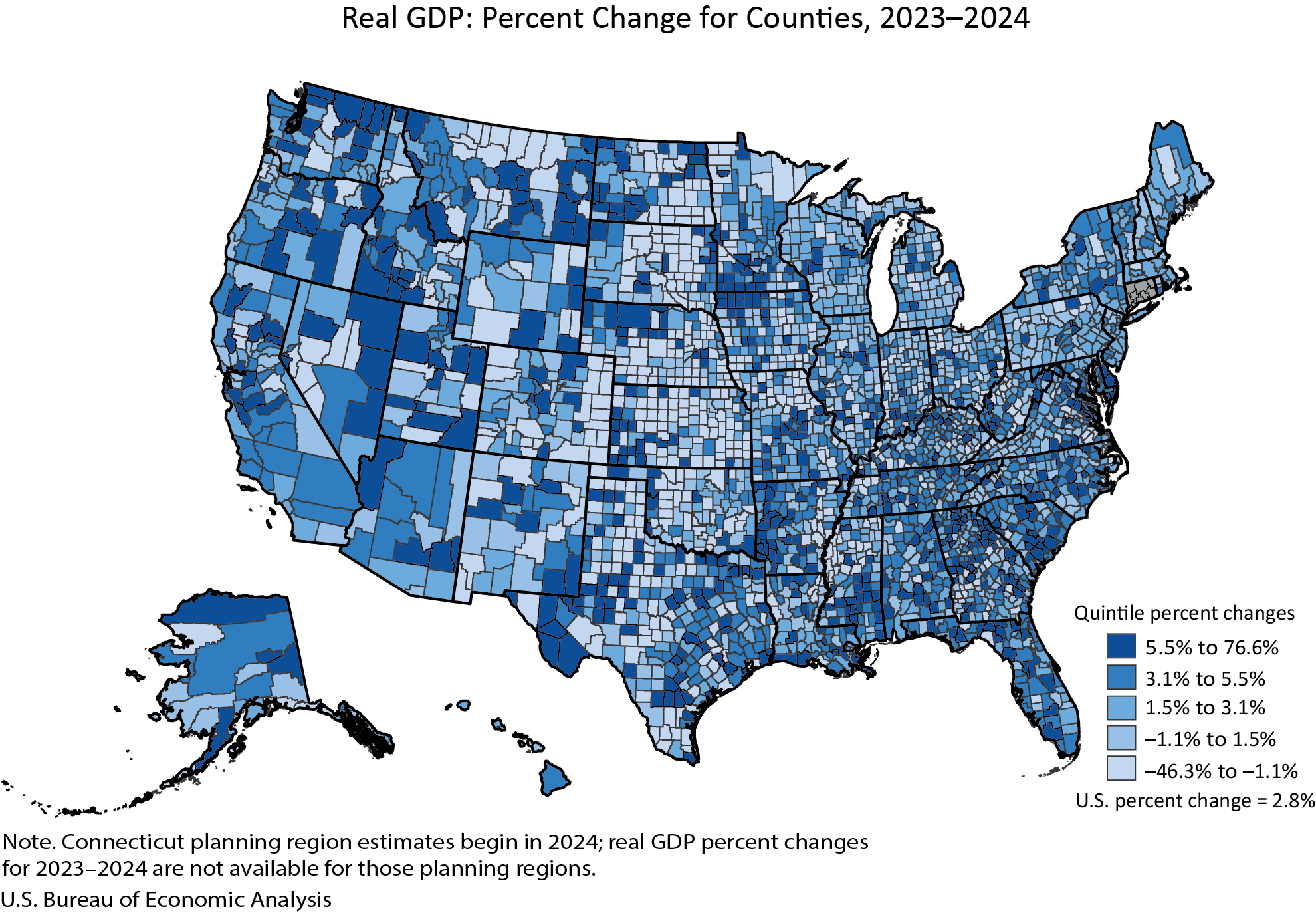
Real gross domestic product (GDP) increased in 2,273 counties, decreased in 809 counties, and was unchanged in 24 counties in 2024. County-level changes ranged from a 76.6 percent increase in Carter County, MT, to a 46.3 percent decline in Baca County, CO.
Personal income, in current dollars, increased in 2,768 counties, decreased in 331, and was unchanged in 7 counties in 2024. County-level changes ranged from a 22.6 percent increase in Harding County, SD, to a 23.3 percent decline in Issaquena County, MS.
Principal Federal Economic Indicators
Noteworthy




The Latest
Personal Income and Outlays, February 2018
Personal income increased 0.4 percent in February, the same increase as in January. Wages and salaries, the largest component of personal income, increased 0.5 percent in February after increasing 0.6 percent in January.
GDP Increases in Fourth Quarter
Real gross domestic product (GDP) increased 2.9 percent in the fourth quarter of 2017, according to the "third" estimate released by the Bureau of Economic Analysis. In the third quarter, real GDP increased 3.2 percent.
Gross Domestic Product, 4th quarter and annual 2017 (third estimate); Corporate Profits, 4th quarter and annual 2017
Real gross domestic product (GDP) increased at an annual rate of 2.9 percent in the fourth quarter of 2017 (table 1), according to the "third" estimate released by the Bureau of Economic Analysis. In the third quarter, real GDP increased 3.2 percent.
State Personal Income Rises in 2017
State personal income increased 3.1 percent on average in 2017, after increasing 2.3 percent in 2016. In 2017, personal income increased in all states and the District of Columbia except one, North Dakota. The percent change in personal income across all states ranged from 4.8 percent in Washington to -0.3 percent in North Dakota.
State Quarterly Personal Income, 4th quarter 2017; State Annual Personal Income, 2017 (preliminary)
State personal income increased 3.1 percent on average in 2017, after increasing 2.3 percent in 2016. In 2017, personal income increased in all states and the District of Columbia except one, North Dakota. The percent change in personal income across all states ranged from 4.8 percent in Washington to -0.3 percent in North Dakota.
U.S. Current-Account Deficit Increases in Fourth Quarter 2017
The U.S. current-account deficit increased to $128.2 billion (preliminary) in the fourth quarter of 2017 from $101.5 billion (revised) in the third quarter of 2017. As a percentage of U.S. GDP, the deficit increased to 2.6 percent from 2.1 percent. The previously published current-account deficit for the third quarter was $100.6 billion.
U.S. International Transactions, 4th quarter and Year 2017
The U.S. current-account deficit increased to $128.2 billion (preliminary) in the fourth quarter of 2017 from $101.5 billion (revised) in the third quarter of 2017. As a percentage of U.S. GDP, the deficit increased to 2.6 percent from 2.1 percent. The previously published current-account deficit for the third quarter was $100.6 billion.
Initial Estimates Show Digital Economy Accounted for 6.5 Percent of GDP in 2016
The Bureau of Economic Analysis released, for the first time, preliminary statistics and an accompanying report exploring the size and growth of the digital economy. Goods and services that are primarily digital accounted for 6.5 percent of the U.S. economy, or $1.2 trillion, in 2016, after a decade of growing faster than the U.S. economy overall, BEA’s research shows.
From 2006 to 2016, the digital economy grew at an average annual…
Initial Statistics on the Size and Growth of the Digital Economy to be Released Thursday
The Bureau of Economic Analysis will release, for the first time, preliminary statistics and an accompanying report exploring the size and growth of the digital economy at 10:30 a.m. on Thursday, March 15.
The report will be available at BEA’s website, www.bea.gov.
The report will include in its definition of the digital economy three major types of goods and services:
BEA Works with Partners to Understand Differences in Bilateral Trade Statistics
Trade statistics produced by the Bureau of Economic Analysis provide policymakers and other stakeholders with critical information for understanding the role of the United States in the global economy. As the size and complexity of international transactions have increased, BEA is working on a number of fronts to make its trade statistics even better.