
Bureau of Economic Analysis
Gross Domestic Product by County and Personal Income by County, 2024
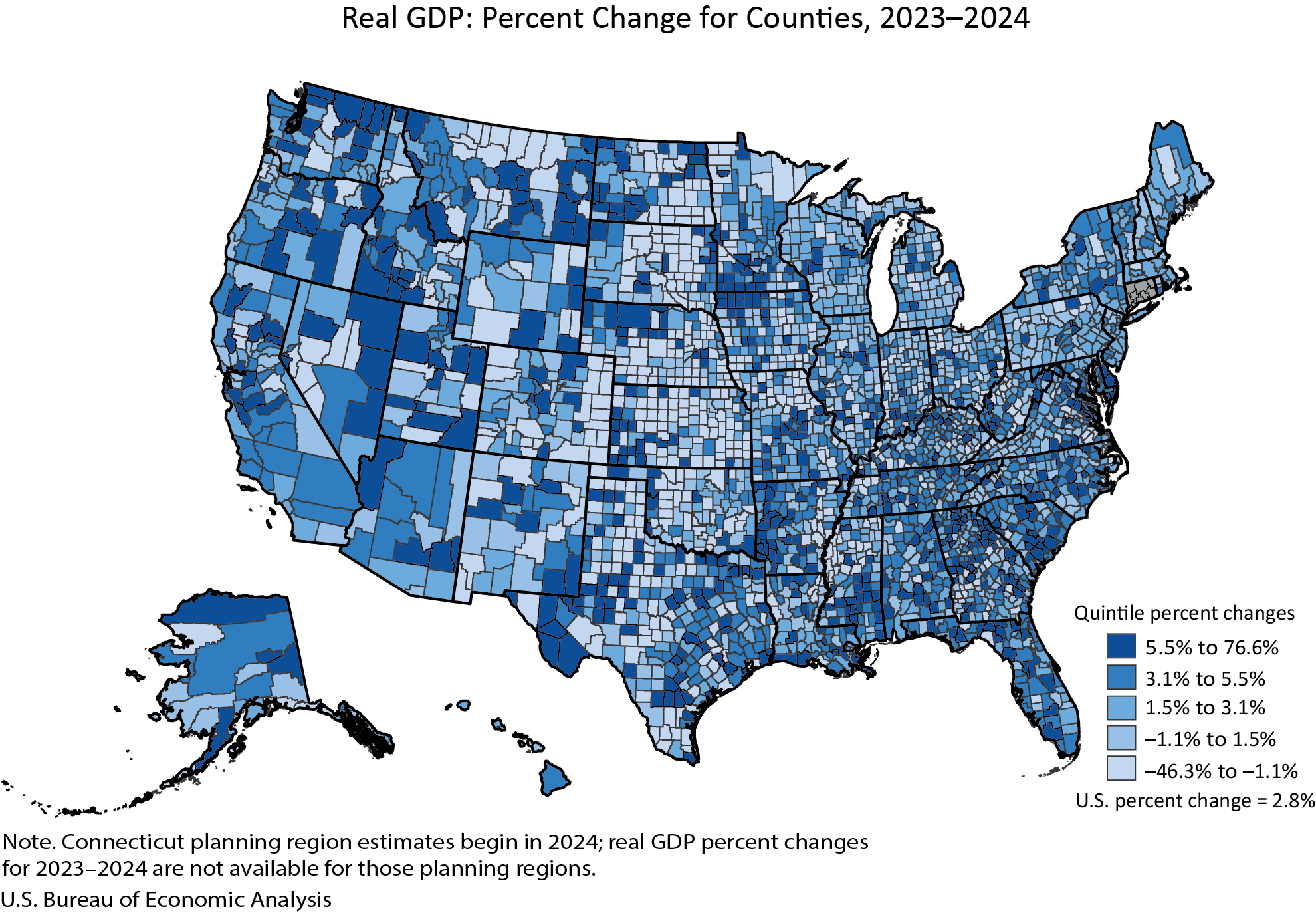
Real gross domestic product (GDP) increased in 2,273 counties, decreased in 809 counties, and was unchanged in 24 counties in 2024. County-level changes ranged from a 76.6 percent increase in Carter County, MT, to a 46.3 percent decline in Baca County, CO.
Personal income, in current dollars, increased in 2,768 counties, decreased in 331, and was unchanged in 7 counties in 2024. County-level changes ranged from a 22.6 percent increase in Harding County, SD, to a 23.3 percent decline in Issaquena County, MS.
Principal Federal Economic Indicators
Noteworthy




The Latest
Gross Domestic Product by Industry, 1st quarter 2016
Construction; health care and social assistance; and retail trade were the leading contributors to the increase in U.S. economic growth in the first quarter of 2016. According to statistics on the breakout of gross domestic product (GDP) by industry released by the Bureau of Economic Analysis, 11 of 22 industry groups contributed to the overall 1.1 percent increase in real GDP in the first quarter.
What's New for the 2016 Annual GDP Update?
The Bureau of Economic Analysis updates GDP figures and their major components every summer, sweeping in more comprehensive data that weren’t available for earlier estimates. The 2016 annual update, coming July 29, also will feature some of BEA’s efforts to continuously improve its measurement of the U.S. economy.
Summer updates to national income and product accounts incorporate data from annual Census Bureau surveys of businesses…
Guest blog: New Advance Economic Indicators Report Available This Month
This is a guest blog by John H. Thompson, Director of U.S. Census Bureau
New Foreign Direct Investment in the United States, 2014 and 2015
Expenditures by foreign direct investors to acquire, establish, or expand U.S. businesses totaled $420.7 billion in 2015, an increase of 68 percent from 2014, when expenditures were $250.6 billion; according to the Bureau of Economic Analysis (BEA) in statistics released today.
Some additional highlights of the statistics on new foreign direct investment for 2015:
New Foreign Direct Investment in the United States, 2014 and 2015
Expenditures by foreign direct investors to acquire, establish, or expand U.S. businesses totaled $420.7 billion in 2015, an increase of 68 percent from 2014, when expenditures were $250.6 billion. In 2015, as in 2014, the majority of the expenditures were to acquire existing businesses. In 2015, expenditures for acquisitions were $408.1 billion. Expenditures to establish new U.S. businesses were $11.2 billion, and expenditures to expand…
Real Personal Income for States, 2014
Real personal income across all regions rose by an average of 2.9 percent in 2014. This growth rate reflects the year-over-year change in nominal personal income across all regions adjusted by the change in the national personal consumption expenditures (PCE) price index. On a nominal basis, personal income across all regions grew an average of 4.4 percent in 2014. In 2014, the U.S. PCE price index grew 1.4 percent.
Real Personal Income for States and Metropolitan Areas
Real personal income across all regions rose by an average of 2.9 percent in 2014. This growth rate reflects the year-over-year change in nominal personal income across all regions adjusted by the change in the national personal consumption expenditures (PCE) price index. On a nominal basis, personal income across all regions grew an average of 4.4 percent in 2014. In 2014, the U.S. PCE price index grew 1.4 percent.
May 2016 Trade Gap is $41.1 Billion
The U.S. monthly international trade deficit increased in May 2016 according to the U.S. Bureau of Economic Analysis and the U.S. Census Bureau. The deficit increased from $37.4 billion in April (revised) to $41.1 billion in May, as exports decreased and imports increased. The previously published April deficit was $37.4 billion. The goods deficit increased $3.7 billion from April to $62.2 billion in May. The services surplus decreased $0.1…
U.S. International Trade in Goods and Services, May 2016
U.S. Census Bureau U.S. Bureau of Economic Analysis NEWS U.S. Department of Commerce * Washington, DC 20230 U.S. INTERNATIONAL TRADE IN GOODS AND SERVICES May 2016 The U.S. Census Bureau and the U.S.
Coming July 13: Statistics on New Foreign Investment in 2014 and 2015
SUITLAND, Md. — Statistics detailing the amount and type of new direct investments made in the United States by foreign investors will be released by the Bureau of Economic Analysis on Wednesday, July 13.
The data will be available in a news release on BEA’s website at 8:30 a.m. eastern time. The statistics cover new direct investments initiated in 2015 and 2014 and will provide information on: