
Bureau of Economic Analysis
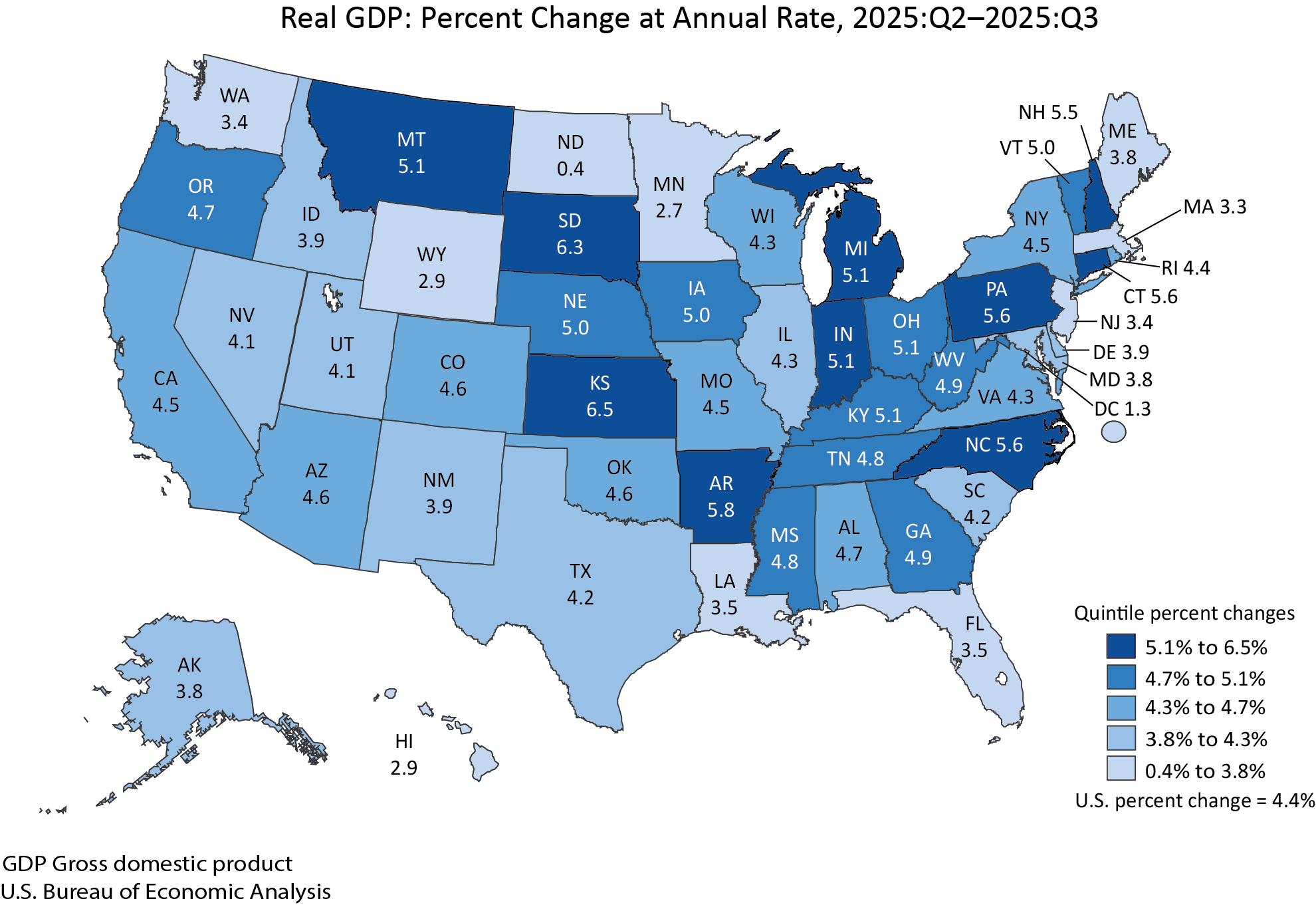
Gross Domestic Product by State and Personal Income by State, 3rd Quarter 2025
Real gross domestic product (GDP) increased in all 50 states and the District of Columbia in the third quarter of 2025. State-level changes ranged from a 6.5 percent increase in Kansas to a 0.4 percent increase in North Dakota.
Personal income increased in all 50 states and the District of Columbia in the third quarter of 2025. State-level changes ranged from a 6.3 percent increase in Kansas to a 0.1 percent increase in Louisiana.
Principal Federal Economic Indicators
Noteworthy




The Latest
U.S. International Trade in Goods and Services, May 2020
The U.S. monthly international trade deficit increased in May 2020 according to the U.S. Bureau of Economic Analysis and the U.S. Census Bureau. The deficit increased from $49.8 billion in April (revised) to $54.6 billion in May, as exports decreased more than imports. The previously published April deficit was $49.4 billion. The goods deficit increased $4.2 billion in May to $76.1 billion. The services surplus decreased $0.6 billion in May to $…
New Foreign Direct Investment in the United States, 2019
Expenditures by foreign direct investors to acquire, establish, or expand U.S. businesses totaled $194.7 billion in 2019, down 37.7 percent from $312.5 billion in 2018.
New Foreign Direct Investment in the United States, 2019
Expenditures by foreign direct investors to acquire, establish, or expand U.S. businesses totaled $194.7 billion in 2019, down 37.7 percent from $312.5 billion in 2018.
U.S. International Investment Position Year 2019
The U.S. net international investment position, the difference between U.S. residents’ foreign financial assets and liabilities, was –$11.05 trillion at the end of 2019, according to statistics released by the U.S. Bureau of Economic Analysis (BEA). Assets totaled $29.15 trillion and liabilities were $40.20 trillion. At the end of 2018, the net investment position was –$9.67 trillion.
U.S. International Investment Position First Quarter 2020
The U.S. net international investment position, the difference between U.S. residents’ foreign financial assets and liabilities, was –$12.06 trillion at the end of the first quarter of 2020, according to statistics released by the U.S. Bureau of Economic Analysis. Assets totaled $26.77 trillion and liabilities were $38.82 trillion. At the end of the fourth quarter of 2019, the net investment position was –$11.05 trillion.
U.S. International Investment Position, First Quarter 2020, Year 2019, and Annual Update
The U.S. net international investment position, the difference between U.S. residents’ foreign financial assets and liabilities, was –$12.06 trillion at the end of the first quarter of 2020, according to statistics released by the U.S. Bureau of Economic Analysis (BEA). Assets totaled $26.77 trillion and liabilities were $38.82 trillion. At the end of the fourth quarter of 2019, the net investment position was –$11.05 trillion.
Personal Income and Outlays, May 2020
Personal Income Personal income decreased 4.2 percent while consumer spending increased 8.2 percent in May, according to estimates released today by the Bureau of Economic Analysis.
Personal Income and Outlays: May 2020
Personal income decreased 4.2 percent while consumer spending increased 8.2 percent in May, according to estimates released today by the Bureau of Economic Analysis.
Gross Domestic Product, First Quarter 2020
Real gross domestic product (GDP) decreased 5.0 percent in the first quarter of 2020, according to the “third” estimate released by the Bureau of Economic Analysis. The decline is the same as in the “second” estimate released in May. In the fourth quarter of 2019, real GDP increased 2.1 percent. For more information, see the Technical Note.
Gross Domestic Product, 1st Quarter 2020 (Third Estimate); Corporate Profits, 1st Quarter 2020 (Revised Estimate)
Real gross domestic product (GDP) decreased 5.0 percent in the first quarter of 2020, according to the “third” estimate released by the Bureau of Economic Analysis. The decline is the same as in the “second” estimate released in May. In the fourth quarter of 2019, real GDP increased 2.1 percent.