
Bureau of Economic Analysis
Gross Domestic Product by State and Personal Income by State, 3rd Quarter 2025
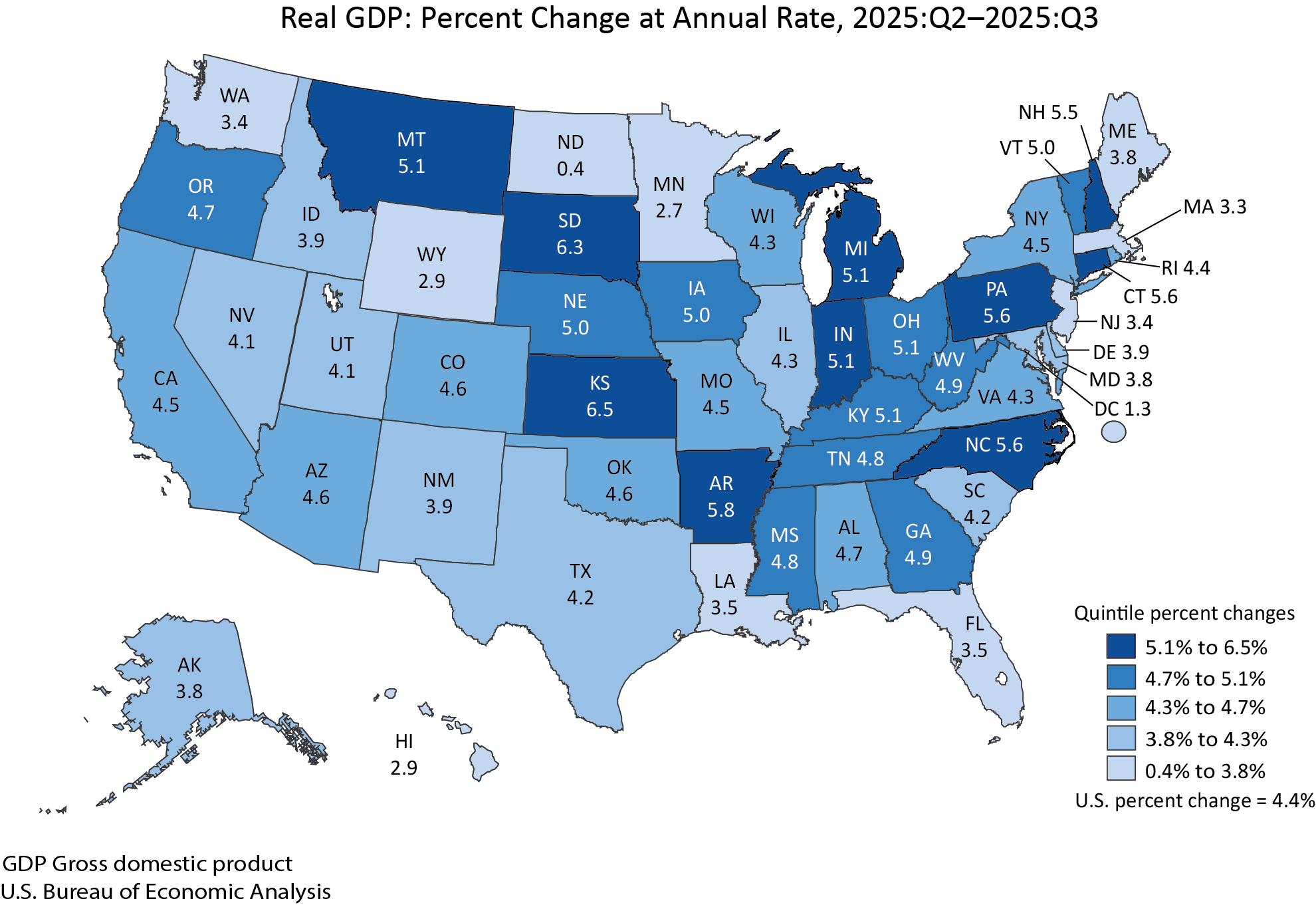
Real gross domestic product (GDP) increased in all 50 states and the District of Columbia in the third quarter of 2025. State-level changes ranged from a 6.5 percent increase in Kansas to a 0.4 percent increase in North Dakota.
Personal income increased in all 50 states and the District of Columbia in the third quarter of 2025. State-level changes ranged from a 6.3 percent increase in Kansas to a 0.1 percent increase in Louisiana.
Principal Federal Economic Indicators
Noteworthy




The Latest
U.S. International Transactions, Fourth Quarter and Year 2019
The U.S. current account deficit narrowed by $15.6 billion, or 12.4 percent, to $109.8 billion in the fourth quarter of 2019, according to statistics from the U.S. Bureau of Economic Analysis. The revised third quarter deficit was $125.4 billion. The fourth quarter deficit was 2.0 percent of current dollar gross domestic product, down from 2.3 percent in the third quarter.
Arts and Culture Economy Grows 3.6 Percent in 2017
Arts and cultural economic activity, adjusted for inflation, increased 3.6 percent in 2017, according to the U.S. Bureau of Economic Analysis. That compares with a 5.3 percent increase in 2016. Arts and cultural economic activity accounted for 4.5 percent of gross domestic product (GDP), or $877.8 billion, in 2017.
Arts and Cultural Production Satellite Account, U.S. and States 2017
The Arts and Cultural Production Satellite Account released today by the U.S. Department of Commerce's Bureau of Economic Analysis (BEA) shows that arts and cultural economic activity, adjusted for inflation, increased 3.6 percent in 2017. That compares with a 5.3 percent increase in 2016. Arts and cultural economic activity accounted for 4.5 percent of gross domestic product (GDP), or $877.8 billion, in 2017.
BE-10 Survey: A Comprehensive Update on U.S. Direct Investment
It's time for BEA's benchmark survey of U.S. direct investment abroad, conducted every five years. This survey is used to produce statistics that capture changing trends in activities of U.S.-owned businesses in other countries. These Bureau of Economic Analysis statistics help business leaders make decisions about hiring and investing. They are used by policymakers and researchers to analyze how investment abroad affects jobs, wages,…
New Statistics Measure How Personal Income Is Distributed
BEA has developed prototype statistics that measure how the nation’s personal income is distributed across households, offering a new tool for assessing how Americans share in the nation’s economic growth.
January 2020 Trade Gap is $45.3 Billion
The U.S. monthly international trade deficit decreased in January 2020 according to the U.S. Bureau of Economic Analysis and the U.S. Census Bureau. The deficit decreased from $48.6 billion in December (revised) to $45.3 billion in January, as imports decreased more than exports. The previously published December deficit was $48.9 billion. The goods deficit decreased $2.6 billion in January to $67.0 billion. The services surplus increased $0.…
2019 Trade Gap is $616.4 Billion
The U.S. international trade deficit decreased in 2019 according to the U.S. Bureau of Economic Analysis and the U.S. Census Bureau. The deficit decreased from $627.7 billion in 2018 to $616.4 billion in 2019, as imports decreased more than exports. As a percentage of U.S. gross domestic product, the goods and services deficit was 2.9 percent in 2019, down from 3.0 percent in 2018. The goods deficit decreased from $887.3 billion in 2018 to $…
U.S. International Trade in Goods and Services, January 2020
The U.S. monthly international trade deficit decreased in January 2020 according to the U.S. Bureau of Economic Analysis and the U.S. Census Bureau. The deficit decreased from $48.6 billion in December (revised) to $45.3 billion in January, as imports decreased more than exports. The previously published December deficit was $48.9 billion. The goods deficit decreased $2.6 billion in January to $67.0 billion. The services surplus increased $0.6…
Personal Income and Outlays, January 2020
Personal income increased 0.6 percent in January after increasing 0.1 percent in December. Wages and salaries, the largest component of personal income, increased 0.5 percent in January after increasing 0.1 percent in December.
Personal Income and Outlays, January 2020
Personal income increased 0.6 percent in January after increasing 0.1 percent in December. Wages and salaries, the largest component of personal income, increased 0.5 percent in January after increasing 0.1 percent in December.