
Bureau of Economic Analysis
Gross Domestic Product by County and Personal Income by County, 2024
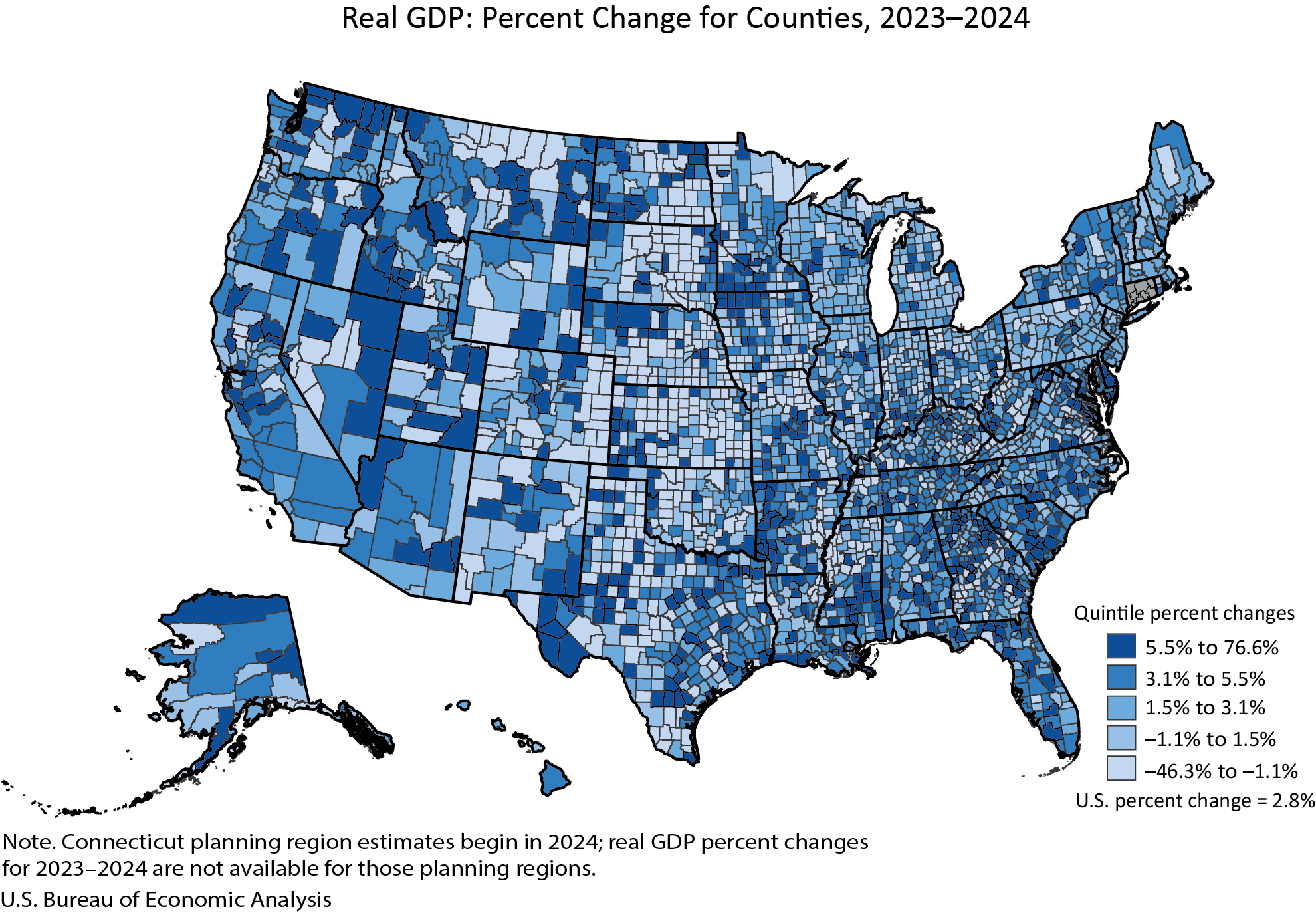
Real gross domestic product (GDP) increased in 2,273 counties, decreased in 809 counties, and was unchanged in 24 counties in 2024. County-level changes ranged from a 76.6 percent increase in Carter County, MT, to a 46.3 percent decline in Baca County, CO.
Personal income, in current dollars, increased in 2,768 counties, decreased in 331, and was unchanged in 7 counties in 2024. County-level changes ranged from a 22.6 percent increase in Harding County, SD, to a 23.3 percent decline in Issaquena County, MS.
Principal Federal Economic Indicators
Noteworthy




The Latest
U.S. Net International Investment Position Second Quarter 2018
The U.S. net international investment position decreased to −$8,638.5 billion (preliminary) at the end of the second quarter of 2018 from −$7,747.3 billion (revised) at the end of the first quarter. The $891.2 billion decrease reflected net financial transactions of −$126.0 billion and net other changes in position, such as price and exchange-rate changes, of −$765.1 billion.
U.S. Net International Investment Position: Second Quarter 2018
The U.S. net international investment position decreased to -$8,638.5 billion (preliminary) at the end of the second quarter of 2018 from -$7,747.3 billion (revised) at the end of the first quarter, according to statistics released by the Bureau of Economic Analysis (BEA).
State Personal Income: Second Quarter 2018
State personal income increased 4.2 percent, at an annual rate, in the second quarter of 2018, a deceleration from the 5.0 percent increase in the first quarter. The percent change in personal income across all states ranged from 6.0 percent in Texas to 1.6 percent in Washington.
State Quarterly Personal Income, 2nd quarter 2018
State personal income increased 4.2 percent, at an annual rate, in the second quarter of 2018, a deceleration from the 5.0 percent increase in the first quarter. The percent change in personal income across all states ranged from 6.0 percent in Texas to 1.6 percent in Washington.
Outdoor Recreation Grew Faster Than U.S. Economy in 2016
The outdoor recreation economy accounted for 2.2 percent of current-dollar GDP in 2016, or $412 billion, updated statistics from the Outdoor Recreation Satellite Account show. In data produced for the first time, using inflation-adjusted GDP, the outdoor recreation economy grew 1.7 percent in 2016, faster than the 1.6 percent growth for the overall U.S. economy.
Real gross output, compensation, and employment all grew faster…
Outdoor Recreation Satellite Account: Updated Statistics for 2012-2016
Updated statistics from the Outdoor Recreation Satellite Account (ORSA) released today by the U.S. Department of Commerce’s Bureau of Economic Analysis (BEA) show that the outdoor recreation economy accounted for 2.2 percent ($412 billion) of current-dollar GDP in 2016. In data produced for the first time, using inflation-adjusted (real) GDP, the outdoor recreation economy grew 1.7 percent in 2016, faster than the 1.6 percent growth for the…
U.S. Current-Account Deficit Decreases in Second Quarter 2018
The U.S. current-account deficit decreased to $101.5 billion (preliminary) in the second quarter of 2018 from $121.7 billion (revised) in the first quarter of 2018. As a percentage of U.S. GDP, the deficit decreased to 2.0 percent from 2.4 percent. The previously published current-account deficit for the first quarter was $124.1 billion.
U.S. International Transactions: Second Quarter 2018
The U.S. current-account deficit decreased $20.2 billion to $101.5 billion (preliminary) in the second quarter of 2018.
Gross Domestic Product by Metropolitan Area, 2017
Real gross domestic product (GDP) increased in 312 out of 383 metropolitan areas in 2017. The percent change in real GDP by metropolitan area ranged from 12.1 percent in Odessa, TX to -7.8 percent in Enid, OK.