
Bureau of Economic Analysis
Gross Domestic Product by County and Personal Income by County, 2024
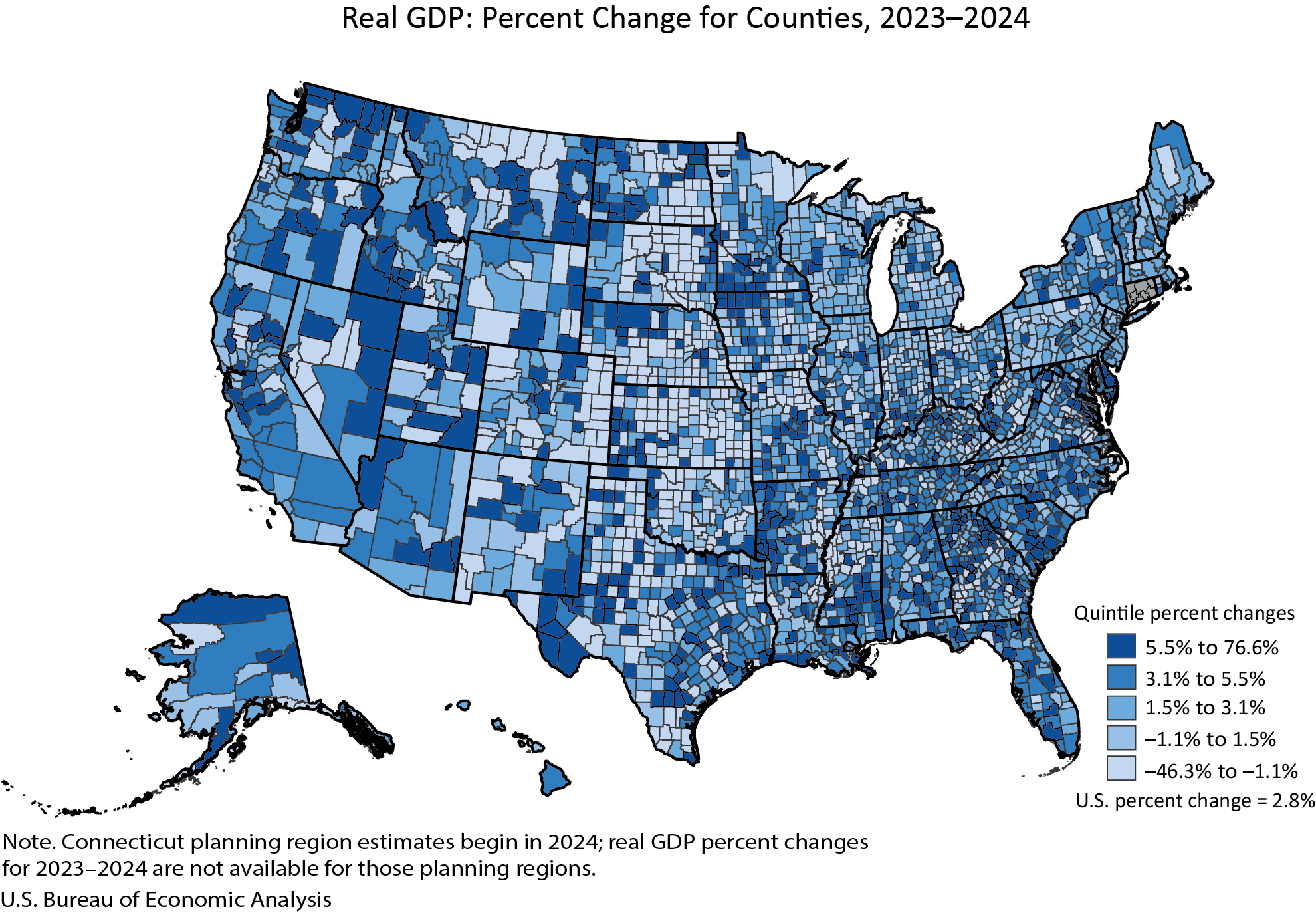
Real gross domestic product (GDP) increased in 2,273 counties, decreased in 809 counties, and was unchanged in 24 counties in 2024. County-level changes ranged from a 76.6 percent increase in Carter County, MT, to a 46.3 percent decline in Baca County, CO.
Personal income, in current dollars, increased in 2,768 counties, decreased in 331, and was unchanged in 7 counties in 2024. County-level changes ranged from a 22.6 percent increase in Harding County, SD, to a 23.3 percent decline in Issaquena County, MS.
Principal Federal Economic Indicators
Noteworthy




The Latest
Gross Domestic Product, Third Quarter 2018 (Second Estimate); Corporate Profits, Third Quarter 2018 (Preliminary Estimate)
Real gross domestic product (GDP) increased 3.5 percent in the third quarter of 2018, according to the “second” estimate released by the Bureau of Economic Analysis. The growth rate was unrevised from the “advance” estimate released in October. In the second quarter, real GDP increased 4.2 percent.
A Detailed Look at Services Supplied to and Received From Foreigners
Looking for the most-up-to-date detailed information on services supplied to and received from foreigners? A recent article in the October Survey of Current Business highlights the latest annual international services statistics now available at BEA.
The statistics cover services provided in two ways:
Local Area Personal Income: 2017
Personal income increased in 2,787 counties, decreased in 318, and was unchanged in 8 in 2017. Personal income increased 4.5 percent in the metropolitan portion of the United States and increased 3.2 percent in the nonmetropolitan portion in 2017. The change in personal income ranged from -41.4 percent in Slope County, North Dakota to 23.7 percent in Crosby County, Texas in 2017 (BEA interactive data).
Local Area Personal Income
Personal income increased in 2,787 counties, decreased in 318, and was unchanged in 8 in 2017. Personal income increased 4.5 percent in the metropolitan portion of the United States and increased 3.2 percent in the nonmetropolitan portion in 2017. The change in personal income ranged from -41.4 percent in Slope County, North Dakota to 23.7 percent in Crosby County, Texas in 2017.
Gross Domestic Product (GDP) by State: Second Quarter 2018
Real gross domestic product increased in all 50 states and the District of Columbia in the second quarter of 2018. The percent change in real GDP in the second quarter ranged from 6.0 percent in Texas to 2.5 percent in Delaware. Information services; real estate and rental and leasing; professional, scientific, and technical services; and durable goods manufacturing were the leading contributors to the increase in real GDP…
Gross Domestic Product by State, 2nd quarter 2018
Real gross domestic product (GDP) increased in all 50 states and the District of Columbia in the second quarter of 2018, according to statistics released today by the U.S. Bureau of Economic Analysis. The percent change in real GDP in the second quarter ranged from 6.0 percent in Texas to 2.5 percent in Delaware.
Guam GDP Increases in 2017
The estimates of GDP for Guam show that real GDP—GDP adjusted to remove price changes—increased 0.2 percent in 2017 after increasing 0.3 percent in 2016. For comparison, real GDP for the United States (excluding the territories) increased 2.2 percent in 2017 after increasing 1.6 percent in 2016.
Guam GDP Increases in 2017
The estimates of GDP for Guam show that real GDP—GDP adjusted to remove price changes—increased 0.2 percent in 2017 after increasing 0.3 percent in 2016. For comparison, real GDP for the United States increased 2.2 percent in 2017 after increasing 1.6 percent in 2016.
Activities of U.S. Affiliates of Foreign Multinational Enterprises, 2016
Majority-owned U.S. affiliates (MOUSAs) of foreign multinational enterprises (MNEs) employed 7.1 million workers (preliminary) in the United States in 2016, a 3.9 percent increase from 6.8 million (revised) in 2015, according to the Bureau of Economic Analysis.
Activities of U.S. Affiliates of Foreign Multinational Enterprises, 2016
Majority-owned U.S. affiliates (MOUSAs) of foreign multinational enterprises (MNEs) employed 7.1 million workers (preliminary) in the United States in 2016, a 3.9 percent increase from 6.8 million (revised) in 2015, according to statistics on MOUSA operations and finances released by the Bureau of Economic Analysis.