
Bureau of Economic Analysis
Gross Domestic Product by County and Personal Income by County, 2024
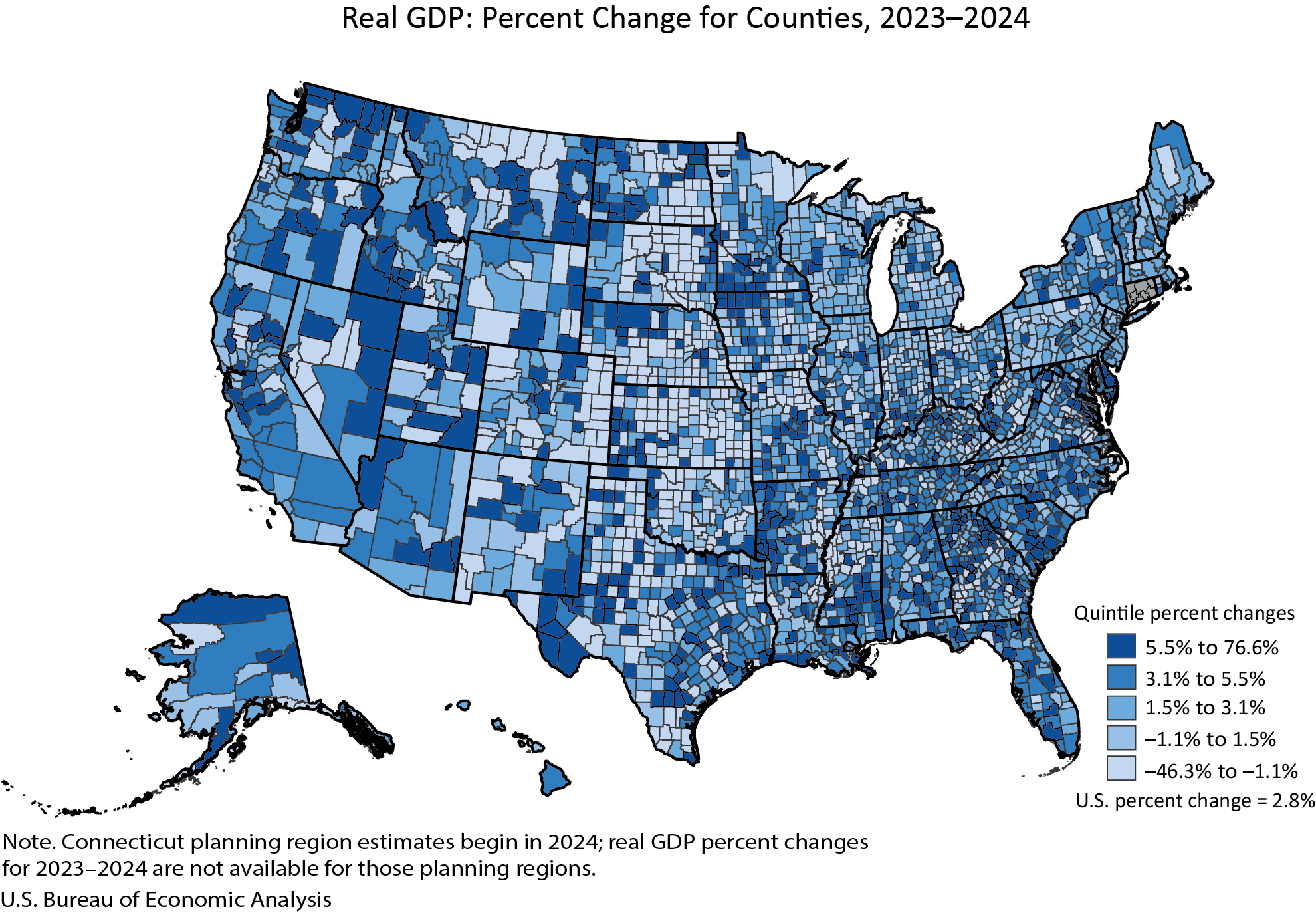
Real gross domestic product (GDP) increased in 2,273 counties, decreased in 809 counties, and was unchanged in 24 counties in 2024. County-level changes ranged from a 76.6 percent increase in Carter County, MT, to a 46.3 percent decline in Baca County, CO.
Personal income, in current dollars, increased in 2,768 counties, decreased in 331, and was unchanged in 7 counties in 2024. County-level changes ranged from a 22.6 percent increase in Harding County, SD, to a 23.3 percent decline in Issaquena County, MS.
Principal Federal Economic Indicators
Noteworthy




The Latest
U.S. Virgin Islands GDP Decreases in 2017
The estimates of GDP for the USVI show that real GDP—GDP adjusted to remove price changes—decreased 1.7 percent in 2017 after increasing 0.9 percent in 2016. For comparison, real GDP for the United States (excluding the territories) increased 2.2 percent in 2017 after increasing 1.6 percent in 2016.
First County GDP Numbers Reveal Differences in Local Economies
Real gross domestic product increased in 1,931 of the nation’s counties and decreased in 1,159 counties in 2015, according to prototype statistics from the U.S. Bureau of Economic Analysis. The inflation-adjusted data show GDP unchanged in 23 counties.
Prototype Gross Domestic Product by County, 2012-2015
The Bureau of Economic Analysis released prototype statistics for gross domestic product (GDP) by county in December 2018. The first official county GDP statistics will be released Dec. 12, 2019, and will include additional detail about industries in each county. The new annual data will cover 2001-2018.
October 2018 Trade Gap is $55.5 Billion
The U.S. monthly international trade deficit increased in October 2018 according to the U.S. Bureau of Economic Analysis and the U.S. Census Bureau. The deficit increased from $54.6 billion in September (revised) to $55.5 billion in October, as exports decreased and imports increased. The previously published September deficit was $54.0 billion. The goods deficit increased $0.9 billion in October to $78.1 billion. The services surplus…
U.S. International Trade in Goods and Services, October 2018
The U.S. monthly international trade deficit increased in October 2018 according to the U.S. Bureau of Economic Analysis and the U.S. Census Bureau. The deficit increased from $54.6 billion in September (revised) to $55.5 billion in October, as exports decreased and imports increased. The previously published September deficit was $54.0 billion. The goods deficit increased $0.9 billion in October to $78.1 billion. The services surplus decreased…
First County GDP Numbers Coming Soon
The U.S. Bureau of Economic Analysis on Dec. 12 will provide an unprecedented look at the size and growth of more than 3,000 county economies across the nation.
Comprehensive Update of Industry Accounts Now Available
The U.S. Bureau of Economic Analysis has released a comprehensive update of its industry statistics, including improvements that reflect the evolving U.S. economy, update the benchmark year, and provide more detailed annual and quarterly data.
Real Consumer Spending Rises in October
Personal income increased 0.5 percent in October after increasing 0.2 percent in September. Wages and salaries, the largest component of personal income, increased 0.3 percent in October, the same increase as in September.
Personal Income and Outlays, October 2018
Personal income increased $84.9 billion (0.5 percent) in October according to estimates released today by the Bureau of Economic Analysis. Disposable personal income (DPI) increased $81.7 billion (0.5 percent) and personal consumption expenditures (PCE) increased $86.9 billion (0.6 percent).
GDP Increases in Third Quarter
Real gross domestic product (GDP) increased 3.5 percent in the third quarter of 2018, according to the “second” estimate released by the Bureau of Economic Analysis. The growth rate was unrevised from the “advance” estimate released in October. In the second quarter, real GDP increased 4.2 percent.
GDP highlights The increase in real GDP reflected increases in consumer spending, inventory investment, government spending, and business…