
Bureau of Economic Analysis
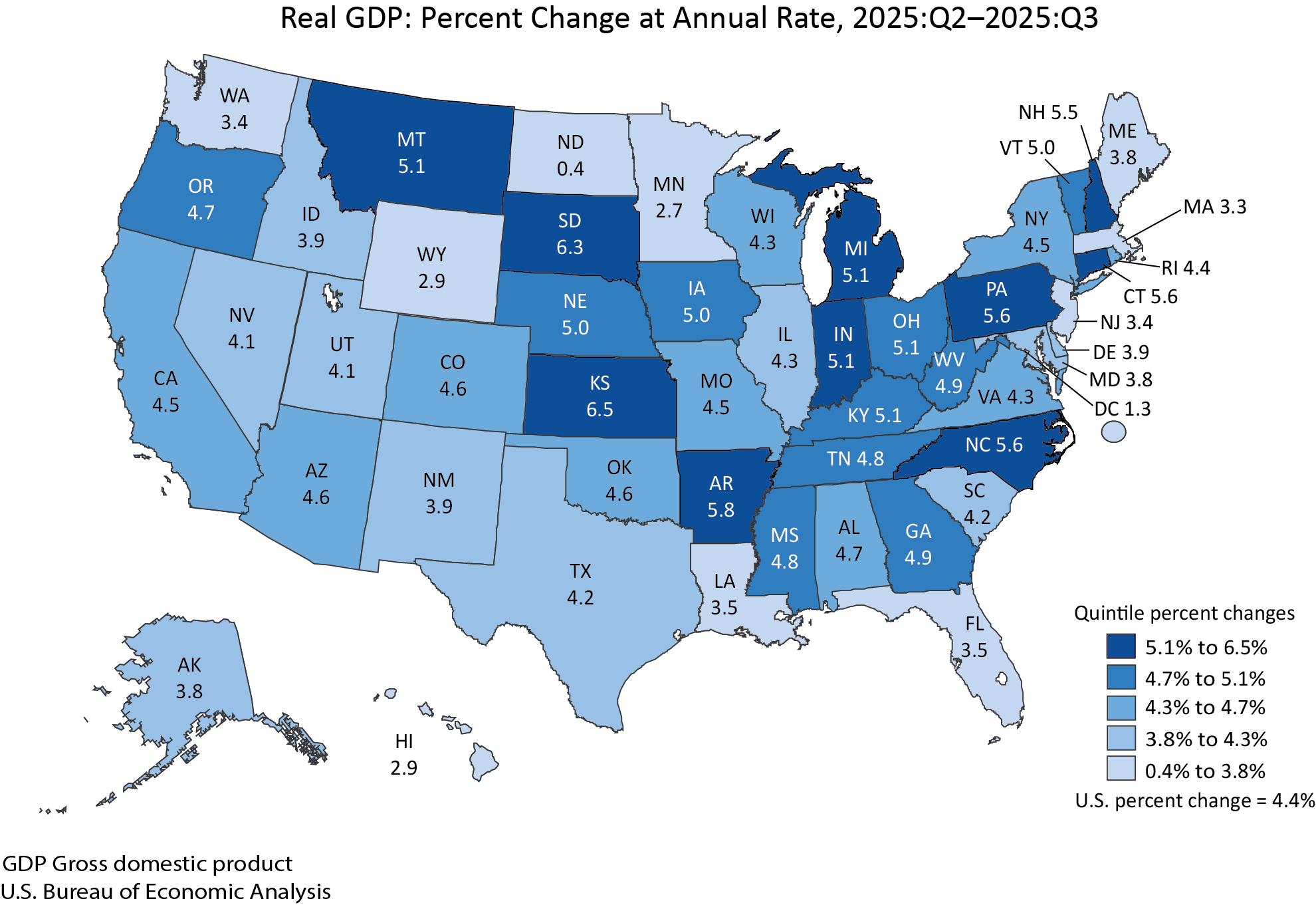
Gross Domestic Product by State and Personal Income by State, 3rd Quarter 2025
Real gross domestic product (GDP) increased in all 50 states and the District of Columbia in the third quarter of 2025. State-level changes ranged from a 6.5 percent increase in Kansas to a 0.4 percent increase in North Dakota.
Personal income increased in all 50 states and the District of Columbia in the third quarter of 2025. State-level changes ranged from a 6.3 percent increase in Kansas to a 0.1 percent increase in Louisiana.
Principal Federal Economic Indicators
Noteworthy




The Latest
Gross Domestic Product for American Samoa, 2020
Real gross domestic product (GDP) for American Samoa increased 4.0 percent in 2020 after decreasing 0.6 percent in 2019. The increase in real GDP reflected widespread growth among the major components of GDP including exports, private inventory investment, and government spending. These increases were partly offset by an increase in imports, which is a subtraction item in the calculation of GDP.
Personal Income and Outlays, October 2021
Personal income increased $93.4 billion, or 0.5 percent at a monthly rate, while consumer spending increased$214.3 billion, or 1.3 percent, in October. The increase in personal income primarily reflected an increase in compensation of employees. The personal saving rate (that is, personal saving as a percentage of disposable personal income) was 7.3 percent in October, compared with 8.2 percent in September.
Personal Income and Outlays, October 2021
Personal income increased $93.4 billion, or 0.5 percent at a monthly rate, while consumer spending increased $214.3 billion, or 1.3 percent, in October. The increase in personal income primarily reflected an increase in compensation of employees. The personal saving rate (that is, personal saving as a percentage of disposable personal income) was 7.3 percent in October, compared with 8.2 percent in September.
Gross Domestic Product, Third Quarter 2021 (Second Estimate); Corporate Profits, Third Quarter 2021 (Preliminary Estimate)
Real gross domestic product (GDP) increased at an annual rate of 2.1 percent in the third quarter of 2021, following an increase of 6.7 percent in the second quarter. The increase was revised up 0.1 percentage point from the “advance” estimate released in October. The deceleration in real GDP in the third quarter was led by a slowdown in consumer spending. A resurgence of COVID-19 cases resulted in new restrictions and delays in the reopening of…
Gross Domestic Product (Second Estimate) Corporate Profits (Preliminary Estimate) Third Quarter 2021
Real gross domestic product (GDP) increased at an annual rate of 2.1 percent in the third quarter of 2021, following an increase of 6.7 percent in the second quarter. The increase was revised up 0.1 percentage point from the “advance” estimate released in October. The deceleration in real GDP in the third quarter was led by a slowdown in consumer spending. A resurgence of COVID-19 cases resulted in new restrictions and delays in the reopening…
Personal Income by County and Metropolitan Area, 2020
In 2020, personal income increased in 3,040 counties, decreased in 69, and was unchanged in 3. Personal income increased 6.4 percent in the metropolitan portion of the United States and increased 7.6 percent in the nonmetropolitan portion. Personal income estimates were impacted by the response to the spread of COVID-19, as governments issued and lifted “stay-at-home” orders. The full economic effects of the COVID-19 pandemic cannot be…
Personal Income by County and Metropolitan Area, 2020
In 2020, personal income increased in 3,040 counties, decreased in 69, and was unchanged in 3. Personal income increased 6.4 percent in the metropolitan portion of the United States and increased 7.6 percent in the nonmetropolitan portion. Personal income estimates were impacted by the response to the spread of COVID-19, as governments issued and lifted “stay-at-home” orders. The full economic effects of the COVID-19 pandemic cannot be…
Activities of U.S. Multinational Enterprises, 2019
Worldwide employment by U.S. multinational enterprises (MNEs) increased 2.4 percent to 43.9 million workers in 2019 from 42.9 million workers in 2018, according to statistics released today by the U.S. Bureau of Economic Analysis (BEA) on the operations and finances of U.S. parent companies and their foreign affiliates.
Activities of U.S. Multinational Enterprises, 2019
Worldwide employment by U.S. multinational enterprises (MNEs) increased 2.4 percent to 43.9 million workers in 2019 from 42.9 million workers in 2018.
BEA Appoints Three New Advisory Committee Members
Three new members are joining the BEA Advisory Committee: Nela Richardson of Automatic Data Processing Inc. (ADP); Louise Sheiner, Brookings Institution; and Heather Stephens, West Virginia University.
The committee advises BEA’s director on matters related to the development and improvement of BEA’s national, regional, and international statistics and provides recommendations from the perspectives of the economics profession,…