
Bureau of Economic Analysis
Gross Domestic Product by County and Personal Income by County, 2024
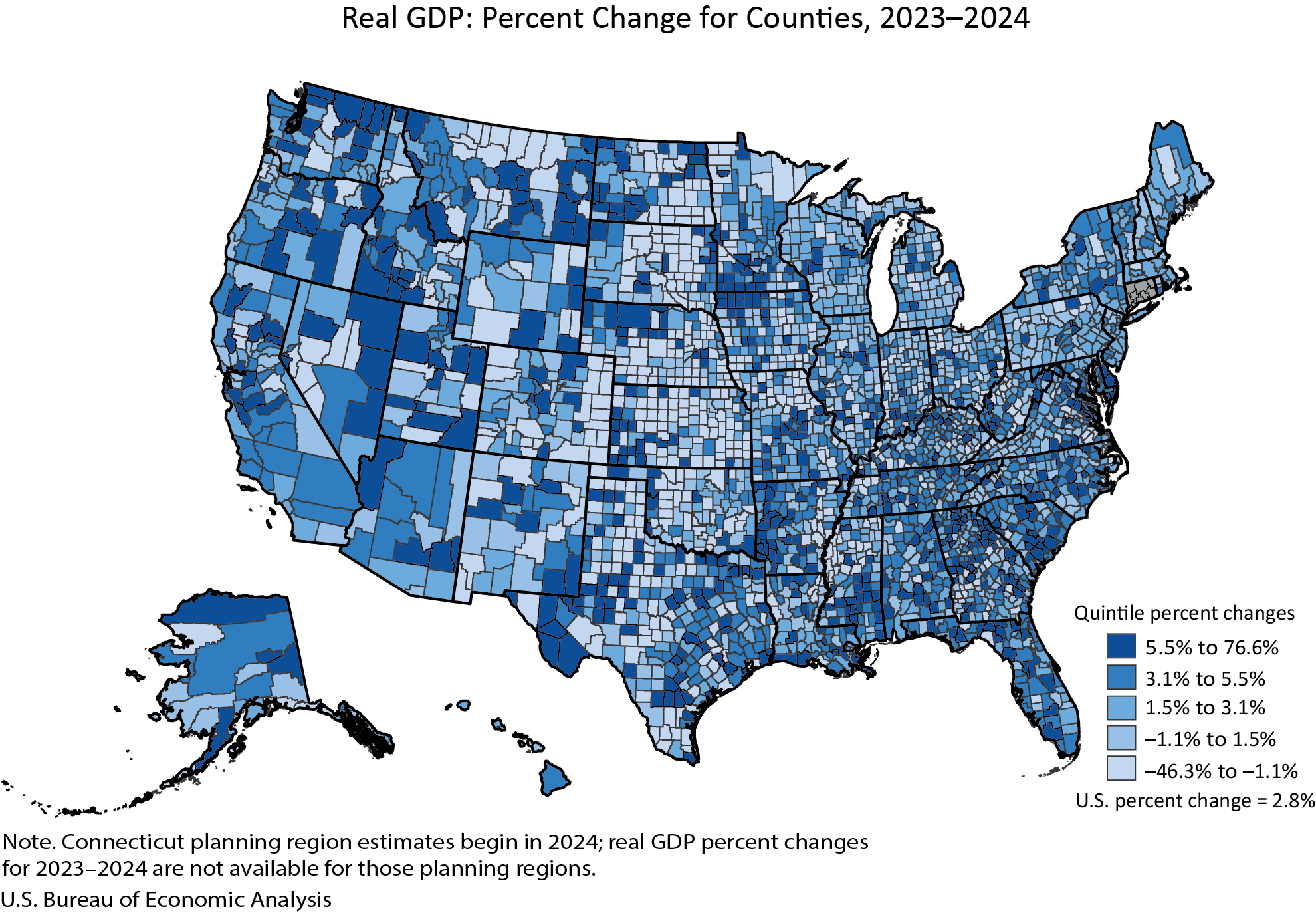
Real gross domestic product (GDP) increased in 2,273 counties, decreased in 809 counties, and was unchanged in 24 counties in 2024. County-level changes ranged from a 76.6 percent increase in Carter County, MT, to a 46.3 percent decline in Baca County, CO.
Personal income, in current dollars, increased in 2,768 counties, decreased in 331, and was unchanged in 7 counties in 2024. County-level changes ranged from a 22.6 percent increase in Harding County, SD, to a 23.3 percent decline in Issaquena County, MS.
Principal Federal Economic Indicators
Noteworthy




The Latest
U.S. International Investment Position Second Quarter 2019
The U.S. net international investment position, the difference between U.S. residents’ foreign financial assets and liabilities, was –$10.56 trillion at the end of the second quarter of 2019, according to statistics released by the U.S. Bureau of Economic Analysis (BEA). Assets totaled $28.01 trillion and liabilities were $38.56 trillion. At the end of the first quarter, the net investment position was –$10.16 trillion.
U.S. International Investment Position, Second Quarter 2019
The U.S. net international investment position, the difference between U.S. residents’ foreign financial assets and liabilities, was –$10.56 trillion at the end of the second quarter of 2019, according to statistics released by the U.S. Bureau of Economic Analysis (BEA). Assets totaled $28.01 trillion and liabilities were $38.56 trillion. At the end of the first quarter, the net investment position was –$10.16 trillion.
Real Disposable Personal Income Rises in August
Personal income increased 0.4 percent in August after increasing 0.1 percent in July. Wages and salaries, the largest component of personal income, increased 0.6 percent in August after increasing 0.2 percent in July.
Personal Income and Outlays, August 2019
Personal income increased 0.4 percent in August after increasing 0.1 percent in July. Wages and salaries, the largest component of personal income, increased 0.6 percent in August after increasing 0.2 percent in July.
GDP Increases in Second Quarter
Real gross domestic product (GDP) increased 2.0 percent in the second quarter of 2019, according to the “third” estimate released by the Bureau of Economic Analysis. The growth rate was the same as in the “second” estimate released in August. In the first quarter, real GDP rose 3.1 percent.
Gross Domestic Product, Second Quarter 2019 (Third Estimate); Corporate Profits, Second Quarter 2019 (Revised)
Real gross domestic product (GDP) increased 2.0 percent in the second quarter of 2019, according to the “third” estimate released by the Bureau of Economic Analysis. The growth rate was the same as in the “second” estimate released in August. In the first quarter, real GDP rose 3.1 percent.
State Personal Income, Second Quarter 2019
State personal income increased 5.4 percent at an annual rate in the second quarter of 2019, a deceleration from the 6.2 percent increase in the first quarter. The percent change in personal income across all states ranged from 7.5 percent in Texas to unchanged in North Dakota.
State Personal Income, Second Quarter 2019
State personal income increased 5.4 percent at an annual rate in the second quarter of 2019, a deceleration from the 6.2 percent increase in the first quarter. The percent change in personal income across all states ranged from 7.5 percent in Texas to unchanged in North Dakota.
Prototype Stats Show Each State's Outdoor Recreation Economy
New prototype outdoor recreation statistics show state value added, compensation, and employment for all 50 states and the District of Columbia. These statistics show that the relative size of the outdoor recreation economy ranged from 5.4 percent of GDP for Hawaii to 1.2 percent for the District of Columbia in 2017.
Outdoor Recreation Satellite Account, U.S. and Prototype for States, 2017
The U.S. outdoor recreation economy accounted for 2.2 percent ($427.2 billion) of current-dollar gross domestic product (GDP) in 2017. The Outdoor Recreation Satellite Account (ORSA) also shows that inflation-adjusted (real) GDP for the outdoor recreation economy grew by 3.9 percent in 2017, faster than the 2.4 percent growth of the overall U.S. economy. Real gross output, compensation, and employment all grew faster in outdoor recreation than…